
You can lose most of your trades and still pass: the math of win rate vs. risk-reward
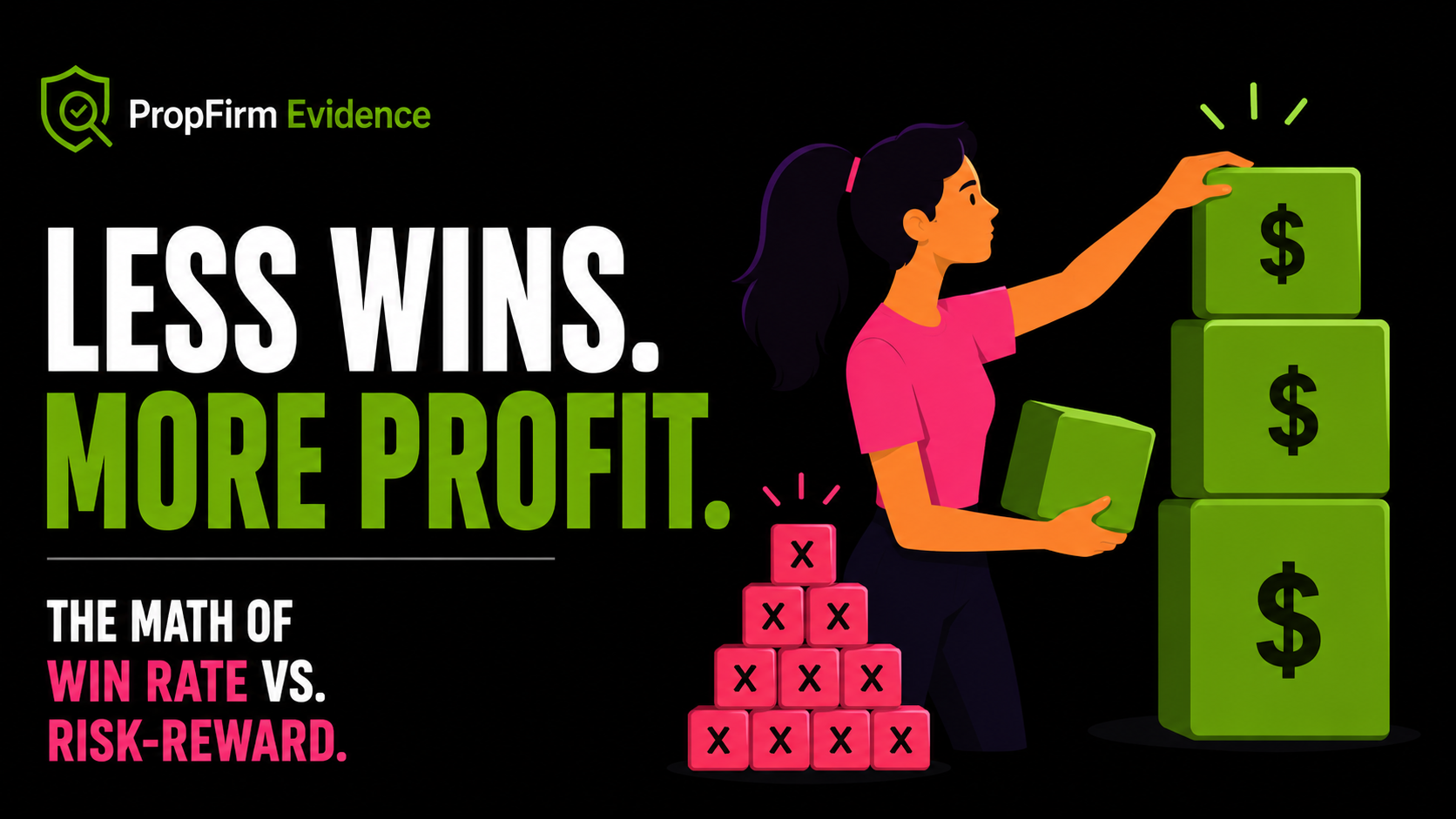
Understanding market structure and reading price action tells you where the good setups are. None of that matters if your risk management is broken, because even a genuinely good read on the market will bleed you dry without a sound plan behind it.
Trading isn’t a game of certainty, it’s a game of probability, and this piece is about the single relationship that decides whether that probability works for you or against you: win rate versus risk-reward ratio.
Trading Is a Marathon, Not a Sprint
Most beginners fail for a very specific reason: they treat trading like a sprint, risking too much on a single “sure thing” and blowing up the account the moment the market inevitably does something unexpected.
Professional trading works on a completely different timescale. The goal was never to win every trade, it’s to manage losses well enough that winning trades can compound into profit over time.
Two Numbers That Only Mean Something Together
Have you ever hit an unusually high win rate and still watched your account balance sit in the red? It’s a frustrating, common paradox, and it comes down to the lack of synergy between two metrics that only tell the real story when read together:
Win rate: the percentage of your trades that close in profit. Take 10 trades, 4 of them profitable, and your win rate is 40%.
Risk-reward ratio (RRR): the relationship between your potential profit and your predefined risk on a given trade. Risk $100 (your stop loss) to target $300 (your profit target), and your RRR is 3:1.
The math is simple enough on its own: the interesting part is what happens when you actually run the numbers on two very different trading styles.
Trader One: High Win Rate, Poor Risk-Reward
This trader hates losing. To keep the win rate high, they take small, quick profits, but let losing trades run in the hope the market reverses.
Win rate: 80% (8 wins, 2 losses)
Risk parameters: risking $100 to make $20
The math: 8 wins × $20 = +$160; 2 losses × $100 = −$200
Result: despite being “right” 80% of the time, this trader ends up with a net loss of $40.
Trader Two: Low Win Rate, Strong Risk-Reward
This trader accepts losses as simply a cost of doing business. They cut losing trades quickly, but let winners run to their full target.
Win rate: 30% (3 wins, 7 losses)
Risk parameters: risking $100 to make $300 (1:3 RRR)
The math: 3 wins × $300 = +$900; 7 losses × $100 = −$700
Result: despite being “wrong” 70% of the time, this trader walks away with a net profit of $200.
Finding Your Own Sustainable Middle Ground
You don’t have to pick an extreme. The goal is finding a sustainable balance that actually fits your own temperament, a win rate that doesn’t demand superhuman precision, paired with an RRR that doesn’t require nerves of steel to hold.
A realistic and genuinely profitable baseline for many traders can sit around a 40–50% win rate combined with a 2:1 risk-reward ratio.
That combination gives you a real psychological cushion: it allows a substantial number of losing trades while maintaining positive expectancy before trading costs, which matters just as much for your ability to keep executing calmly as it does for the balance itself.
The Breakeven Math Behind Every RRR
It helps to see exactly how much win rate a given RRR actually needs just to break even, before any profit target is even in play:
| Risk-Reward Ratio | Breakeven Win Rate |
|---|---|
| 1:1 | 50.00% |
| 2:1 | 33.33% |
| 3:1 | 25.00% |
| 4:1 | 20.00% |
| 5:1 | 16.67% |
| 6:1 | 14.29% |
| 7:1 | 12.50% |
| 8:1 | 11.11% |
| 9:1 | 10.00% |
| 10:1 | 9.09% |
| 11:1 | 8.33% |
Notice how quickly the required win rate falls as the RRR climbs. At 3:1, you only need to be right roughly a quarter of the time to break even before costs; performance above that threshold produces positive expectancy.
This is exactly the mechanism behind Trader Two’s result above: a strong RRR can turn a losing majority of trades into a profitable overall outcome.
Protecting a Funded Evaluation
As a general rule for long-term survival, risk as little as possible per trade, ideally somewhere between 0.5% and 1%.
Risking a small percentage doesn’t necessarily mean small absolute results. On larger account sizes, a modest percentage risk per trade can still translate into meaningful simulated gains.
There’s no universal answer here, though. The ideal risk per trade depends entirely on your specific win rate and risk-reward ratio, the same math from the examples above, applied to your own actual numbers rather than someone else’s.
What This Comes Down To
Trading is a marathon. Success isn’t winning every trade, it’s managing losses so winning trades can carry the overall result.
Win rate needs a matching RRR. A high win rate is worthless if it’s paired with a poor risk-reward ratio; your net result depends on the balance between the two, not either number alone.
You can be wrong most of the time and still profit. With a risk-reward ratio such as 3:1, losing the majority of your trades can still be compatible with positive expectancy.
Find your own sweet spot. A 40–50% win rate combined with a 2:1 RRR provides an example of a balance between profitability, capital protection and psychological sustainability.
What Comes Next
The next part in this series goes deeper into the psychology behind all of this, why sticking to these risk-management rules is so difficult once fear, greed, or frustration take the wheel, and how to build the kind of discipline that keeps you executing the plan even when your own mind is working against you.