
The math was never the hard part: the mental game of a funded evaluation
If you’ve followed this series so far, you already know that risk management is straightforward arithmetic. A 2:1 risk-reward ratio, applied consistently, lets you lose more than half your trades and still come out ahead. The math checks out on paper every single time.
So if the math is this simple, why do so many developing traders still fail their evaluation?
The honest answer isn’t flattering: the math doesn’t have emotions. You do. Trading is one of the most unforgiving mirrors available — it reflects your impatience, your ego, your greed, and your fear back at you in real time.
Staying disciplined on a small demo account can feel easy precisely because little appears to be at stake. The moment evaluation pressure enters the picture, everything about your decision-making can change, even though the strategy underneath hasn’t moved an inch.
What the Pressure Is Actually Testing
A funded evaluation isn’t only a test of your strategy — it’s also a test of your emotional control under a specific kind of pressure: hit a target return without breaching a strict drawdown limit.
For a lot of newer traders, that target return quietly turns into an obsession.
The moment your attention shifts entirely onto the outcome — the number you need to hit — instead of the process that’s supposed to produce it, you enter a state of quiet desperation.
You stop trading the market that’s actually in front of you and start trading your own need to hit the target. That shift in focus is the root of three of the most damaging habits in trading.
Three Traps Worth Naming Explicitly
If you’ve ever blown an account, these will feel uncomfortably familiar. If you haven’t, you’ve almost certainly felt the pull toward all three at some point.
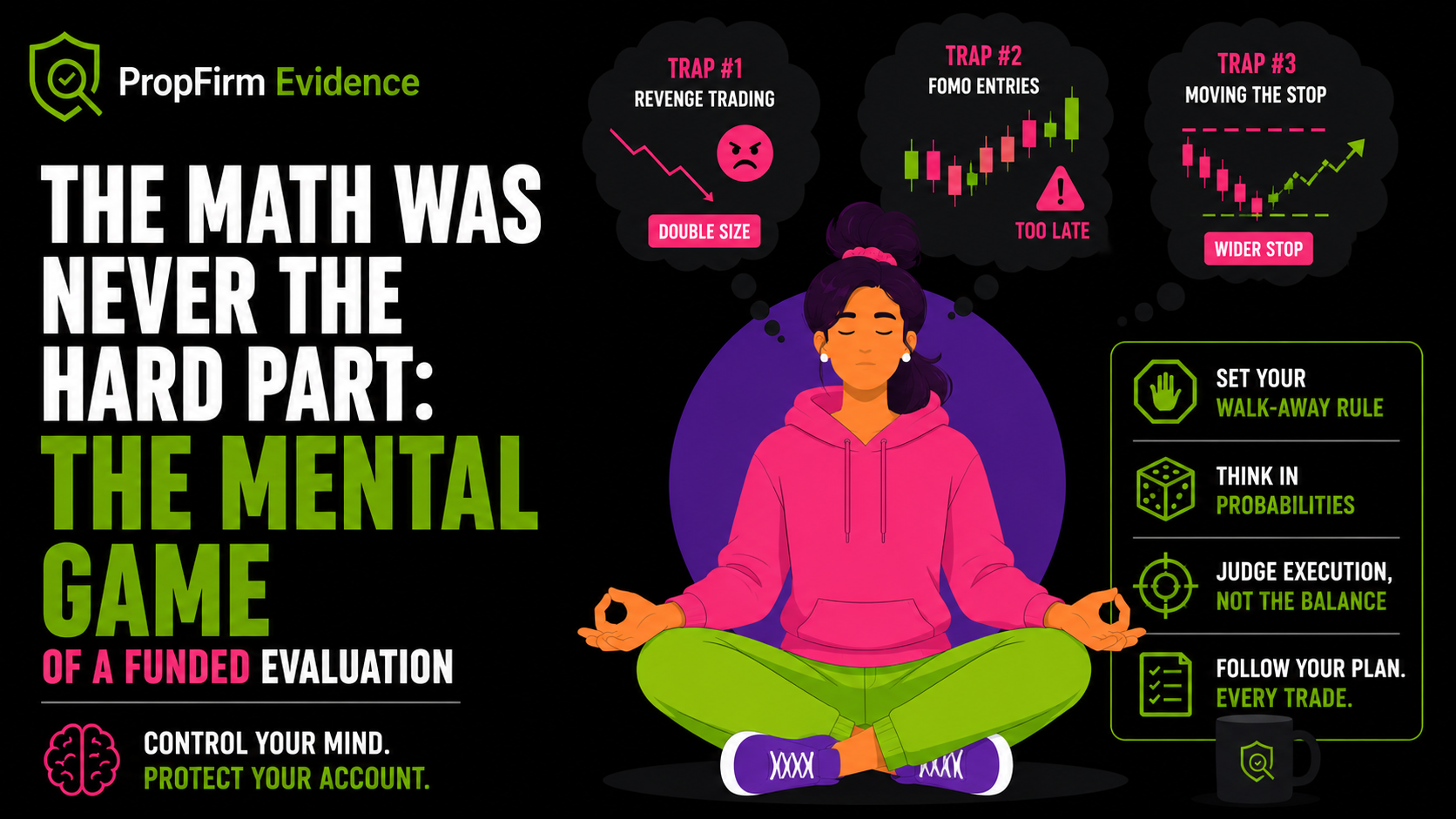
Trap One: Revenge Trading
A completely normal, statistically expected loss happens. Your ego takes the hit personally.
Instead of accepting it and stepping back, you feel an overwhelming urge to win it back immediately — so you open another position, often in the opposite direction and often at double the size, ignoring your plan entirely.
At that point you’re no longer trading the market. You’re fighting it.
Trap Two: FOMO-Driven Entries
You open the charts and see a large candle already shooting in one direction. Your actual setup isn’t there, but you click anyway, afraid the move will leave without you.
By the time you’re in, the move may already be exhausted. Price reverses, and you’re left holding a position that was never part of your original trading plan.
Trap Three: Moving the Stop Loss
A trade goes against you and approaches your predefined stop.
Rather than accepting the calculated 1% loss, you widen the stop, hoping for a reversal. It doesn’t come. You widen it again.
What started as a small, calculated cost of doing business has quietly become a large, uncalculated loss.
Building Discipline That Actually Holds
Recognizing these traps is step one. Step two is putting rules in place that protect you from your own emotional state before it takes over.
This is one of the ways experienced traders attempt to maintain consistency when pressure increases.
Set Your Own Walk-Away Rule
Set your own walk-away rule, tighter than the official limit. Whatever daily loss limit an evaluation enforces, consider setting your own personal ceiling well inside it — for example, 2%.
Hit that number, close the platform, step away from the screens, and don’t come back until the next trading session.
A single bad day should never be allowed to threaten the whole attempt.
Think in Probabilities, Not Certainties
Think in probabilities, not certainties. No individual setup guarantees a particular outcome.
If your trading strategy has demonstrated a positive expectancy over a sufficiently meaningful sample of trades, a single losing trade should not automatically invalidate the strategy.
The purpose of probability-based thinking is to judge the strategy across a series of trades rather than demanding that every individual position succeed.
Judge Execution, Not the Account Balance
Judge execution, not the account balance. Hide the balance display if you need to.
Your primary job in the moment is executing your trading plan precisely.
A trade where you followed your rules, placed your stop correctly and got stopped out can still represent good execution.
A trade where you made money after breaking your own trading rules can represent poor execution, regardless of the profitable outcome.
What This Comes Down To
Mindset matters alongside the math. A mathematically positive trading approach can be undermined if emotion and pressure repeatedly change the way it is actually executed.
Process over outcome. Fixating on a target return can push traders toward forcing trades. Focus instead on executing the trading plan consistently.
Avoid all three traps. Revenge trading, chasing entries through FOMO and widening a predefined stop can all turn controlled risk into uncontrolled risk.
Set a personal walk-away rule. A tighter personal daily loss threshold can force you away from the charts before one difficult session becomes significantly more damaging.
Redefine what a good trade actually is. A good trade is one where you followed your rules precisely — whether it ultimately closed in profit or in loss.