
The observer trader: why you are not your thoughts while trading
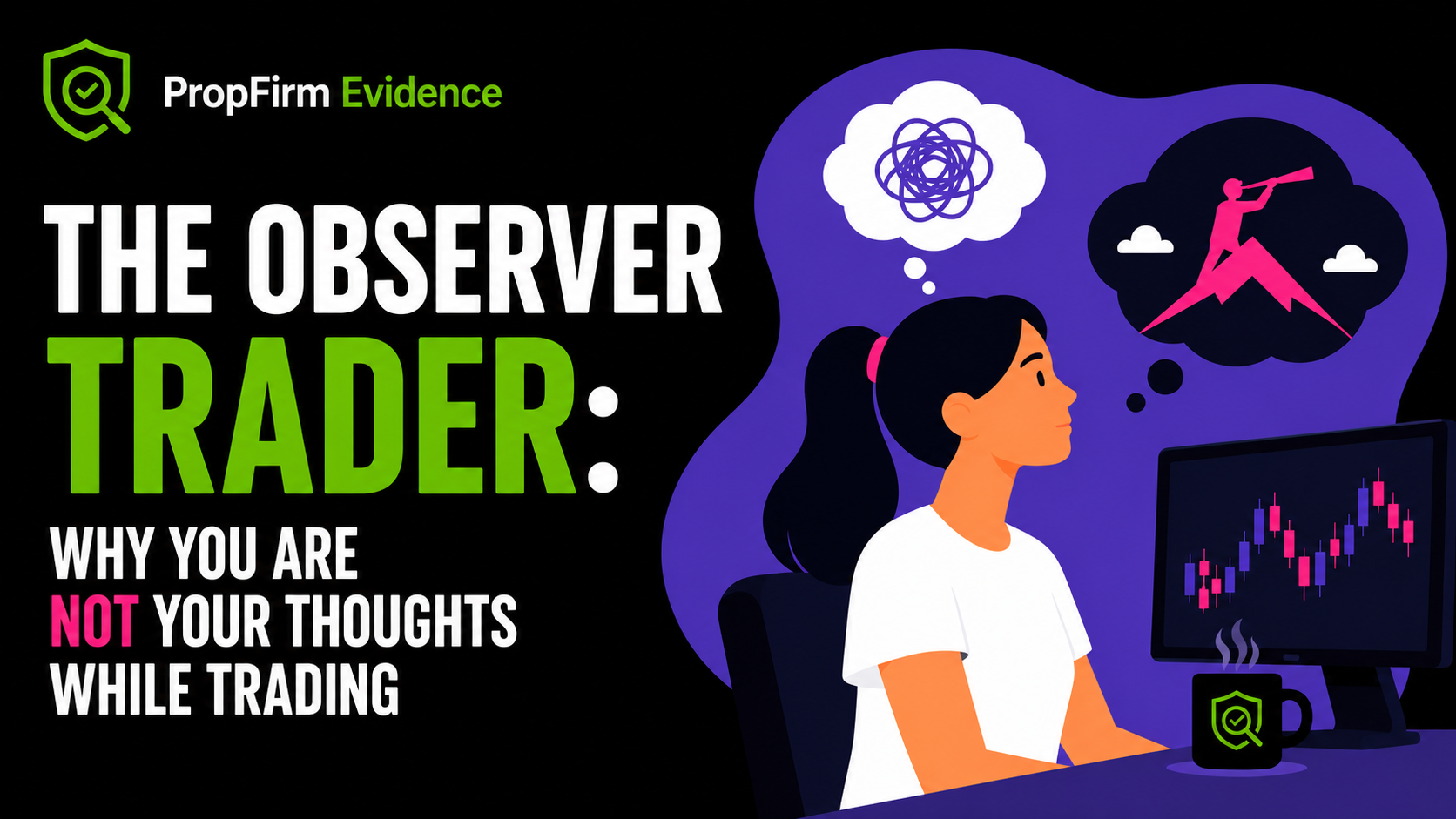
There is a particular moment in trading that can have a major influence on what happens next.
It often appears a few seconds before an impulsive decision, when a thought arrives:
“This is about to reverse.”
“I’ve already lost too much today.”
“This time it’s really the one.”
The thought itself is not necessarily the problem.
The problem begins when the thought is treated automatically as if it were an objective fact or an instruction that has to be followed.
This is where self-awareness becomes useful: noticing what is happening internally before it becomes an unexamined trading decision.
The Chain Nobody Edits
One useful way to examine impulsive trading behaviour is through a simple sequence:
Thought → emotion → action → outcome
Real human behaviour is more complicated than a single linear chain. Thoughts, emotions, physical reactions and behaviour can influence each other in both directions.
But as a practical trading model, the sequence can help identify where intervention is possible.
Consider the difference between:
“I think this move could be a trap.”
And:
“This always happens to me.”
The first is a thought or hypothesis that can still be examined.
The second is a much broader interpretation that may begin influencing behaviour automatically.
The objective is not to eliminate strong or negative thoughts. Traders will experience them.
The useful skill is recognising when a thought is present before allowing it to alter a decision that was made according to the trading plan.
Emotional Regulation and Self-Awareness
These two skills are related, but they are not exactly the same.
Emotional Regulation
Emotional regulation refers to ways of responding to an emotional state so that it becomes easier to manage.
That might include:
Stepping away from the screen.
Slowing down before acting.
Using controlled breathing.
Ending the trading session when predefined limits are reached.
These techniques can help reduce the intensity of a reaction or create time before another decision is made.
Self-Awareness
Self-awareness is the ability to notice the thought, feeling or impulse that is occurring while it is happening.
Instead of immediately acting from fear, frustration or excitement, the trader first recognises:
“This is what I’m currently thinking.”
“This is what I’m currently feeling.”
“Now, what does my trading plan actually require?”
Regulation can help manage the reaction.
Self-awareness can help identify what was occurring before the reaction became a trading decision.
Both can be useful, and neither needs to replace the other.
The Separation Exercise
A simple exercise is to compare one difficult recent trade with one well-executed recent trade.
For each trade, ask:
What was I thinking immediately before entering?
What was I thinking while the trade was open?
What emotion accompanied those thoughts?
Did that emotion change a decision I had already made before entering?
For example:
Did I move the stop?
Did I close early?
Did I add size?
Did I ignore an exit rule?
Did I enter another trade immediately afterwards?
The purpose is not to assume that every losing trade was caused by emotion.
A correctly executed strategy will still produce losses.
The purpose is to separate normal strategy losses from decisions that changed because the trader departed from the original plan.
Becoming an Observer, Not a Crisis Manager
Awareness does not mean fighting every uncomfortable thought.
It means recognising it before deciding whether it deserves an action.
For example:
“This is fear of giving back today’s gains.”
“This is frustration after the previous loss.”
“This is the urge to recover the money immediately.”
“This is overconfidence after several winning trades.”
Labelling the reaction can create a small amount of separation between the experience and the decision.
One useful language shift is:
Instead of:
“I have to get out now.”
Try:
“I’m having the thought that I need to get out now.”
The market has not changed because of that sentence.
What changes is the trader’s relationship to the thought.
It becomes something that can be examined rather than something that automatically has to be obeyed.
Return to the Trading Plan
Once the thought has been recognised, the next question should be mechanical:
Has anything changed that invalidates the trade according to my predefined rules?
If the answer is yes, the plan may require action.
If the answer is no, the emotional reaction alone may not justify changing the position.
This distinction is important.
The objective is not to ignore new market information simply because a trading plan exists.
A good plan should already define what information is allowed to change the trade and what conditions invalidate the original setup.
Self-awareness helps distinguish between:
“The strategy’s exit condition has appeared.”
And:
“I feel uncomfortable and want the uncertainty to end.”
Why This Is Trainable
Self-awareness does not have to remain an abstract psychological idea.
It can be incorporated into the same record-keeping process used to analyse strategy performance.
A trading journal can record:
Entry and exit
Setup
Risk
Outcome
Dominant thought before entry
Dominant emotion before entry
Thoughts that appeared while the trade was open
Whether those thoughts caused a rule change
Emotional state after the trade
Over a sufficiently large number of trades, patterns may begin to appear.
For example, the journal might show that stop-loss interference occurs more frequently after consecutive losses, or that overtrading appears more often after an unusually profitable morning.
That converts an apparently vague psychological issue into something that can at least be observed and reviewed systematically.
A Simple Observer-Trader Process
A practical process can be reduced to five steps:
1. Notice. What thought or emotion has appeared?
2. Name it. Fear, frustration, urgency, overconfidence, FOMO or something else?
3. Separate it. Treat the thought as an internal event rather than automatically as a market fact.
4. Check the plan. Has a predefined trading condition actually changed?
5. Record it. Add the event to the journal so recurring patterns can be reviewed later.
The goal is not perfect emotional control.
The goal is to create a small decision point between impulse and action.
When Journaling Alone Is Not Enough
Some behavioural patterns are easy to identify but difficult to change.
A trader may understand perfectly well that they are revenge trading, repeatedly increasing risk or interfering with stops and still find the same behaviour returning.
In those circumstances, additional outside support may be useful.
That could include structured coaching focused on trading behaviour or, where the issue extends beyond trading or causes significant distress, support from an appropriately qualified mental-health professional.
Seeking another perspective is not fundamentally different from reviewing a trading system with someone else when your own analysis is no longer identifying the problem clearly.
What This Comes Down To
A thought is not automatically a fact. The feeling that a market is about to reverse does not itself prove that the strategy’s exit condition has been reached.
Emotion is not the enemy. Fear, frustration and excitement can appear without automatically becoming trading actions.
Create separation before acting. Naming a thought can make it easier to examine rather than immediately obey.
Return to predefined rules. The question is not simply how you feel about the trade, but whether the conditions defined by the strategy have actually changed.
Journal the internal process. Thoughts and emotions can be recorded alongside normal trading data to identify recurring execution patterns.
Measure behaviour over time. One emotional trade proves very little. Repeated patterns across many trades provide much more useful information.
Conclusion
You are not required to act on every thought that appears when a market moves against you.
You can notice the thought, name it and compare it against the trading plan before deciding what happens next.
That small gap between impulse and action is where self-awareness becomes useful.
It does not guarantee profitable trading, and it cannot repair a strategy without an edge.
But when a trader already has defined rules and repeatedly finds that their own reactions interfere with executing them, learning to observe those reactions can become an important part of improving consistency.
The objective is not to become emotionless.
It is to become better at recognising when an emotion is present without automatically giving it control of the trade.