
Off the chart, on your performance: the two-way street between life and trading
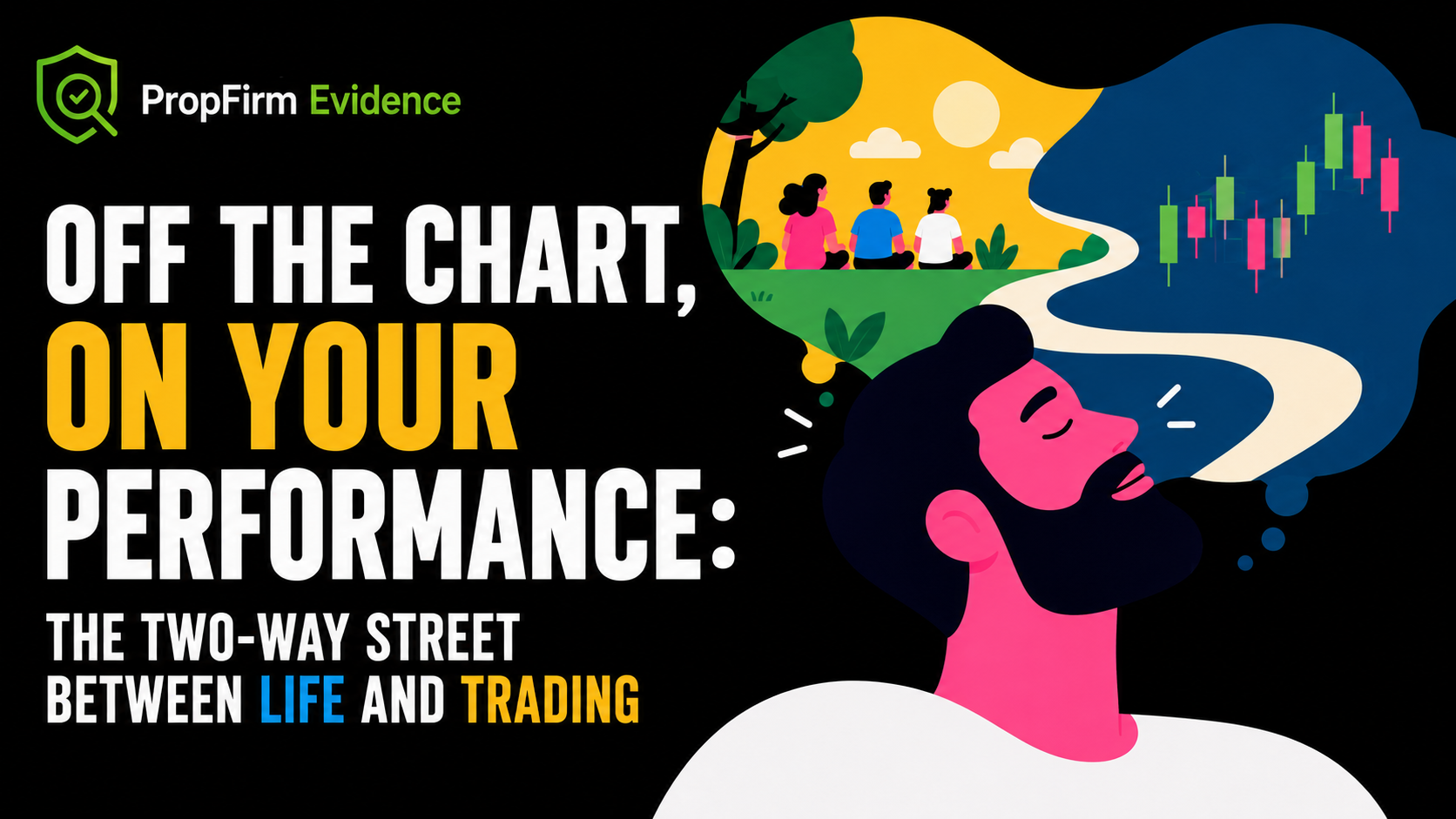
Ask traders what is affecting their results and many will point immediately to the chart: a poor entry, a missed signal, a stop that was hit or a trade that was managed badly.
What is easier to overlook is everything that happened before the trading session even began.
Poor sleep, personal stress, fatigue, conflict, financial pressure or simply spending too much time focused on markets can all influence the conditions under which decisions are being made.
The relationship can also work in the opposite direction. Trading can begin affecting sleep, relationships, routines and the amount of attention available for life outside the market.
That makes trading performance and life outside the charts less separate than they can initially appear.
Trading Is Not an Isolated Skill
Trading psychology is sometimes reduced to controlling emotions while a position is open.
That is only one part of the picture.
A trader arrives at the market carrying whatever physical and psychological state has developed before the session begins.
That may include:
Sleep quality
Fatigue
Stress
Distraction
Financial pressure
Conflict outside trading
General workload
These factors do not automatically cause poor trading decisions, but they can influence concentration, patience and the way risk is perceived.
This is why preparation for trading does not necessarily begin when the chart is opened.
Not Trading Is Sometimes a Valid Decision
One of the less discussed trading skills is recognising when current circumstances make good execution significantly more difficult.
The market may be available, but participation is still optional.
A trader who is severely tired, distracted by a serious personal issue or unable to concentrate may decide that the conditions required by their own trading plan are not present.
That is not necessarily a failure of discipline.
It can be viewed as another form of risk management.
A trading plan can therefore include conditions under which no trading takes place.
For example:
If I have had insufficient sleep, I reduce activity or do not trade.
If I cannot concentrate on the session, I step away.
If a significant personal event is dominating my attention, I do not force normal trading activity.
If I notice repeated rule violations, I stop and review before continuing.
The exact rule will depend on the individual. The important point is that the decision can be made in advance rather than improvised under pressure.
Your Relationship With Money Matters Too
Money does not carry the same psychological meaning for every trader.
A loss that feels routine to one person may feel highly significant to another.
Financial pressure can also influence behaviour.
A trader who feels they urgently need trading profits to pay for normal living costs may experience a position very differently from someone trading capital they can afford to expose to risk.
That pressure can potentially affect:
Position sizing
Willingness to accept losses
How long winning trades are held
The temptation to recover losses quickly
The number of trades taken
This does not mean every trading mistake has a deep psychological explanation.
It means financial context is another variable worth recognising when reviewing behaviour.
Make the Connection Visible With a Journal
It is easy to believe that personal state affects trading performance.
It is more useful to record enough information to see whether that relationship actually appears in your own results.
A journal can include normal trade information alongside a few simple measures of personal state.
For example:
Hours of sleep
Energy level
Stress level
Ability to concentrate
Dominant emotion before the session
Whether something outside trading was distracting you
Whether trading rules were followed
This allows the trader to compare state with execution rather than simply assuming a connection exists.
Build an Emotional Vocabulary
Useful journaling also requires being able to describe what was happening with some precision.
“I felt bad” provides relatively little information.
More specific observations might include:
Frustrated
Impatient
Overconfident
Anxious
Tired
Distracted
Fearful of losing existing profit
Eager to recover a previous loss
The purpose is not to diagnose yourself.
It is simply to create a more accurate record of the circumstances surrounding the decision.
Correlation Is Not Automatically Causation
Suppose your journal shows that several poor trading sessions occurred after nights of poor sleep.
That is useful information, but it does not automatically prove that lack of sleep caused every poor decision.
Similarly, one profitable week during a low-stress period does not establish that reduced stress was responsible for the profits.
Look for repeated patterns across a meaningful sample.
Then test practical changes.
For example, if execution consistently deteriorates after very poor sleep, you might introduce a rule that limits trading under those conditions and compare subsequent results.
The journal becomes most useful when observations lead to something measurable rather than simply becoming explanations after the event.
Build the Boring Infrastructure Around Trading
A sustainable trading routine does not necessarily require dramatic lifestyle changes.
Often the most useful support comes from relatively ordinary habits.
A Consistent Start to the Day
A morning routine can create separation between waking up and immediately entering a decision-intensive environment.
That might include:
Hydration
Food
Movement or exercise
A short period away from screens
Reviewing the day’s trading plan
The objective is not to create a perfect morning ritual.
It is to avoid beginning a trading session in an unnecessarily rushed or distracted state.
A Written Plan for the Day
Trading does not need to be the only structured part of the day.
Knowing when you intend to trade, work, exercise, spend time with other people and stop looking at markets can create boundaries around the activity.
Without those boundaries, trading can gradually expand to fill whatever time is available.
Deliberate Time Away From Screens
Time away from market information allows attention to shift toward other parts of life.
That may mean:
Exercise
Time outdoors
Family
Friends
Reading
Another hobby or interest
The specific activity matters less than maintaining parts of life that are not dependent on market performance.
A Genuine Day Off
A day without placing trades is not always the same as a day away from trading.
If the entire day is still spent checking charts, reviewing prices and thinking about open markets, psychological distance may remain limited.
For some traders, deliberately scheduling periods without market monitoring can help preserve clearer boundaries between trading and recovery time.
The Relationship Runs Both Ways
Just as life circumstances can influence trading, trading behaviour can begin influencing life outside the market.
Possible warning signs include:
Repeatedly checking markets during family or social time
Sleep being disrupted by positions or market monitoring
Other interests gradually disappearing
Mood becoming heavily dependent on daily trading results
Difficulty stepping away from charts even when no trade is planned
Trading activity creating financial or relationship problems
None of these behaviours on its own establishes a clinical problem.
But repeated interference with normal life is worth taking seriously rather than automatically interpreting it as dedication.
Dedication and Over-Involvement Are Not the Same Thing
Professional commitment requires time and attention.
But more screen time does not automatically produce better decisions.
A trader can spend twelve hours looking at charts and still make worse decisions than someone who follows a defined two-hour trading window.
The useful question is not simply:
“How much time am I spending trading?”
It is:
“Is the time I am spending improving the process, or am I simply remaining psychologically attached to the market?”
This distinction can be difficult to see without occasionally stepping away.
When to Take the Problem More Seriously
If trading begins causing persistent distress, major financial harm or substantial disruption to relationships, sleep, work or everyday functioning, a journal and better routine may not be enough.
At that point, seeking appropriate professional support can be a reasonable step.
The objective should not be to prove that you can tolerate unlimited pressure.
It should be to maintain a relationship with trading that remains compatible with the rest of your life.
A Simple Life-and-Trading Check
At the end of each week, consider asking:
How well did I sleep?
How often did outside stress interfere with trading?
How often did trading interfere with life outside the market?
Did I follow my trading hours?
Did I take meaningful time away from charts?
Did my mood become strongly tied to P&L?
Were my poorest decisions associated with identifiable states or circumstances?
Is there one practical change worth testing next week?
This turns balance from a vague lifestyle idea into something that can be reviewed alongside the rest of the trading process.
What This Comes Down To
You do not arrive at the chart as a blank slate. Sleep, stress, distraction and financial circumstances can influence the environment in which trading decisions are made.
Not trading can be part of risk management. If your ability to execute is materially compromised, stepping away may be more consistent with the plan than forcing participation.
Measure before assuming. Record personal state alongside trading behaviour and look for recurring relationships rather than explaining every loss psychologically.
Build boundaries around trading. Defined trading hours, routines and genuine time away from markets can help prevent the activity from consuming the rest of the day.
The relationship works both ways. Life can affect trading, and trading can begin affecting sleep, relationships, finances and other priorities.
More trading is not automatically better trading. Quality of execution matters more than remaining connected to the market continuously.
Conclusion
Your trading performance and your life outside the charts are not completely separate systems.
The state in which you arrive at the market can influence the way you execute, and the way you engage with trading can influence the rest of your life in return.
That does not mean every difficult trading session should be blamed on sleep, stress or psychology.
It means those variables deserve to be measured alongside strategy, risk and execution when they repeatedly appear relevant.
Build the routine. Keep the journal. Know the conditions under which stepping away is sensible.
And periodically ask a question that has nothing to do with win rate or risk-reward:
Is trading still fitting into my life, or is my life increasingly being built around trading?
A sustainable trading process should be capable of coexisting with the person who has to execute it.