
Prop Firm Payout Proof: Real Trader Experiences
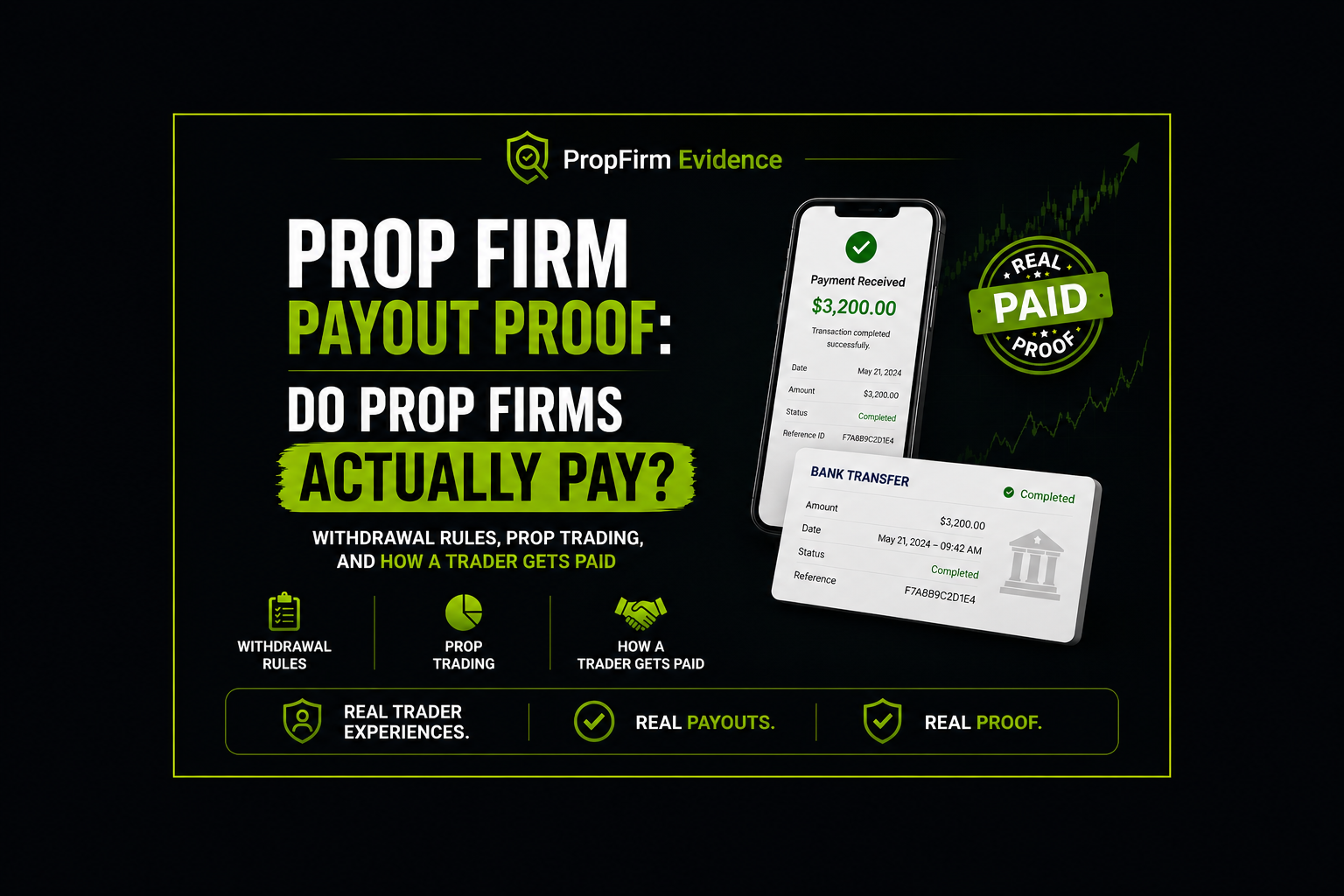
Prop firms often promote large payout screenshots, impressive profit split offers, and stories of traders who get paid quickly.
Some of those claims are real.
Some are incomplete.
A screenshot is not always proof that a withdrawal reached the trader. It may only show an internal dashboard, an approved request, or a marketing certificate.
That matters because passing a prop firm challenge is only the first part of the process.
The real test comes later, when a profitable trader asks to withdraw their share.
This guide explains how prop firm payout proof works, what real evidence looks like, why some firms delay or deny payouts, and how to choose a prop firm with clearer rules and more reliable payouts.
Why Prop Firms Need Real Payout Evidence
Prop firms can look professional from the outside.
A firm may have a clean website, strong branding, affiliate reviews, social media posts, and large payout claims. But none of that proves the trader actually received money.
Real evidence matters because the withdrawal stage is where trust is tested.
A reliable firm should show that it pays traders according to its published rules. It should also explain its payout policies clearly before a trader buys a challenge.
Many prop firms operate with strict conditions. A trader may pass the evaluation, reach the profit target, follow the trading day requirement, and still face problems if the terms are vague.
Before trusting any firm, ask:
- Did the trader follow the rules?
- Was the withdrawal request submitted correctly?
- Was the account reviewed fairly?
- Was the money actually received?
- How long did the process take?
- Did support explain any delay?
- Were any extra conditions added later?
A payout screenshot can support a claim.
It should not be the whole claim.
How Prop Firm Payouts Actually Work
Most prop firms use a similar model.
A trader enters a prop firm evaluation, passes the required stages, receives access to a funded or simulated funded account, then earns a share of eligible profits.
That share is usually called the profit split.
For example, a firm may offer an 80% profit split. This means the trader keeps 80% of eligible profits, while the firm keeps 20%.
The exact payout structure depends on the company.
Some firms pay monthly. Some pay every two weeks. Some offer an on-demand payout. Some advertise fast payouts or payouts within 24 hours.
The important question is not only what the firm offers.
The important question is whether the firm pays consistently when traders meet the rules.
The Typical Payout Structure
A typical prop firm payout structure may include:
- A minimum number of trading days.
- A first withdrawal waiting period.
- A profit split percentage.
- A minimum profit amount.
- KYC checks.
- Account review before approval.
- Approved payment methods.
- Restrictions that can block payment.
This is where many traders make a mistake.
They focus on account size and challenge price but ignore the withdrawal terms.
The terms are just as important as the trading rules.
The Usual Payout Process
A normal payout process may look like this:
- The trader meets the required conditions.
- The trader submits a payout request.
- The firm reviews the account.
- The firm checks for rule violations.
- The request is approved or rejected.
- The trader receives the money through the agreed method.
Problems often appear during the review stage.
The firm may check news trading, risk limits, copy trading, account sharing, unusual execution, position size, or prohibited trading strategies.
A review is not automatically a warning sign.
A vague review with no clear reason is.
What Counts as Real Prop Firm Payout Proof?
Prop firm payout proof should show more than a branded certificate.
A certificate may be useful, but the firm controls its own certificates, dashboard, and marketing posts.
Real payouts need stronger evidence.
Payment Confirmation
The strongest proof is confirmation from outside the firm’s platform.
This may include:
- A bank transaction.
- A payment provider record.
- A crypto transaction, if relevant.
- A completed status.
- The amount received.
- The date.
- A transaction reference.
Personal information should be hidden.
But the key details should remain visible enough to understand whether the payment was completed.
Matching Withdrawal Records
Good evidence connects the external payment to the firm’s dashboard.
For example, the trader may show:
- The withdrawal request.
- The amount requested.
- The date submitted.
- The approval status.
- The payment method.
- The amount received externally.
This makes the claim much stronger.
A dashboard that only says “paid” is weaker. It may be accurate, but it does not prove that money arrived outside the firm’s system.
A Complete Timeline
A useful report should show the full sequence.
For example:
- The trader requested payment on Monday.
- The firm reviewed the account on Tuesday.
- The request was approved on Wednesday.
- The money arrived on Thursday.
This helps traders judge payout speed.
It also separates normal processing from unreasonable delay.
If a firm claims to process payouts quickly, there should be repeated evidence across real traders, not just one promotional example.
Prop Trading Rules That Affect Withdrawal Approval
Prop trading is different from trading your own personal account.
You are operating inside the firm’s rules.
That means your trading style must fit the terms before you start.
A strategy that works on a personal account may cause problems in prop firm trading if the firm restricts certain behaviour.
Trading Day Requirements
Some firms require a minimum number of trading days before a trader can request payment.
This means you may not be able to place one trade, make a profit, and withdraw immediately.
Check what counts as a trading day.
Some firms require meaningful activity. Others count any closed trade. Small details can affect whether the request is valid.
News Trading Rules
News trading is a common source of disputes.
Some firms allow it.
Some restrict it.
Some ban opening or closing trades around high-impact events.
A trader who ignores these rules may lose the payment, even if the trade was profitable.
Check the exact news window.
Do not assume every firm handles news the same way.
Trading Style Restrictions
Your trading style should match the firm’s conditions.
Scalping, swing trading, hedging, martingale systems, high-frequency execution, copy trading, and overnight holding may be treated differently by different firms.
If your method sits close to a restricted area, ask support for written confirmation before buying.
Do not rely on assumptions.
Why Firms Deny Payouts
Some denied requests are valid.
If a trader breaks published rules, exceeds drawdown, uses restricted strategies, trades during banned news periods, or shares an account, the firm may have the right to reject the payment.
The concern begins when firms deny payouts using vague wording, unclear rules, or conditions that were not obvious before purchase.
Common Rule Violations
Common reasons include:
- Breaching daily loss limits.
- Breaching maximum drawdown.
- Breaking news trading rules.
- Using prohibited trading strategies.
- Copy trading without permission.
- Account sharing.
- Exceeding position size limits.
- Violating consistency rules.
- Using platform manipulation.
The key question is whether the rule was clear before the trader paid.
A trustworthy firm should explain the exact rule, identify the affected trades, and provide enough detail for the trader to understand the decision.
Vague Explanations
Weak explanations often sound like this:
- “Your account is under review.”
- “Your activity breached our risk policy.”
- “Your request has been rejected due to prohibited behaviour.”
Those statements are not enough on their own.
A trader should ask for:
- The exact rule.
- The exact trades involved.
- The relevant timestamps.
- The reason the activity was prohibited.
- The appeal process.
Legitimate firms should be able to support serious decisions with clear evidence.
Rule Changes After Purchase
Another warning sign is when a firm changes payout policies after the trader has bought the account.
Every prop firm can update its terms.
The problem is when new rules are applied to existing traders without clear notice, especially when those rules affect a pending withdrawal.
Traders should save dated copies of the rules when purchasing.
This includes terms, FAQs, challenge rules, payout policies, news rules, and profit split conditions.
Warning Signs of Misleading Payout Claims
Not every public claim is reliable.
Some are genuine. Some are promotional. Some are incomplete. Some are designed mainly to sell challenge accounts through affiliate links.
You do not need to assume every claim is fake.
You need to check the evidence.
Dashboard Screenshots Only
A dashboard screenshot can be useful, but it is not complete proof.
It shows what the firm’s system says.
It does not prove the trader received money.
A stronger report includes external confirmation and a clear timeline.
Cropped or Edited Images
Be cautious when screenshots hide too much.
It is normal to hide personal details.
It is not helpful when the image hides the date, amount, payment status, or transaction context.
If the screenshot only shows a big number and a logo, it has limited value.
Affiliate-Heavy Reviews
Many prop firm reviews are made by affiliates.
That does not automatically make them dishonest.
But affiliate content should be treated carefully because the reviewer may earn money when traders sign up.
A useful review should disclose the relationship and still discuss rules, risks, complaints, payment evidence, and rejected withdrawals.
If a review only praises the firm and shares a discount code, it is not enough.
Prop Firm Payout Statistics and Marketing Claims
Prop firm payout statistics can be useful, but they need context.
Some major firms publish total payouts, average payout speed, largest payments, or the number of funded traders paid.
Those figures may sound impressive.
But they do not always tell you:
- How many traders requested payment.
- How many requests were rejected.
- Why requests were rejected.
- How long processing took.
- Whether rules changed.
- Whether traders received the full profit split.
- Whether the claims were independently verified.
Statistics are only one part of the picture.
Look for detailed payout histories, independent trader reports, clear terms, and consistent behaviour over time.
Do Prop Firms Actually Pay?
Some prop firms actually pay.
Some pay slowly.
Some pay only after strict reviews.
Some reject requests fairly.
Some reject requests in ways that raise serious concerns.
The better question is this:
Does this specific firm have enough evidence to show that payouts actually work for real traders under clear rules?
Search for Payouts From Prop Firms
Look for payouts from prop firms that include complete details.
Good evidence includes the original request, approval message, external transaction, dates, and payment method.
Be careful with posts that only show a certificate.
A certificate may support the story, but it should not be treated as final proof.
Compare Positive and Negative Reports
Do not only look for happy stories.
Search for:
- Delayed withdrawal reports.
- Denied payment complaints.
- Rule violation disputes.
- Trustpilot reviews.
- Reddit discussions.
- YouTube reviews.
- Telegram or Discord complaints.
- Public responses from the firm.
The goal is not to find one angry trader and assume the firm is unsafe.
The goal is to see whether complaints form a pattern.
Look for Consistent Payouts
Consistent payouts matter more than one impressive screenshot.
A firm with reliable payouts should have repeated evidence from different traders over time.
Look for reports across different months, account sizes, countries, and payment methods.
If every positive claim comes from affiliates, sponsored accounts, or the firm’s own social media, keep looking.
Real traders should be able to explain the process clearly.
How Payouts Work Across Different Firms
Not every proprietary trading firm works the same way.
Some firms use one-step challenges. Some use two-step models. Some offer instant funding. Some focus on simulated accounts. Some use stricter consistency checks than others.
A typical prop firm may check:
- Whether the trader passed the evaluation correctly.
- Whether minimum trading days were met.
- Whether drawdown rules were respected.
- Whether position sizing stayed within limits.
- Whether the account used restricted strategies.
- Whether identity verification was completed.
This is why reading the rules matters.
A good offer is not just a large account size.
It is a clear, fair, and understandable payment system.
How to Choose a Prop Firm With Reliable Payouts
Choosing a firm should not be based only on account size, challenge price, or discount codes.
A cheap challenge is not a good deal if the rules are unclear or the firm has poor payment behaviour.
The right prop firm is one where the rules are clear, the process is documented, and the company has a record of treating traders fairly.
What Reputable Firms Usually Provide
Reputable firms tend to provide:
- Clear legal entity details.
- Transparent payout policies.
- Real payment evidence.
- Fair profit split terms.
- Clear withdrawal methods.
- Consistent trader feedback.
- Reasonable challenge rules.
- Clear support communication.
- Published prohibited strategies.
- A fair appeal process.
Legitimate firms do not need to hide basic information.
They should make it easy for traders to understand how payment works before buying an account.
Questions to Ask Before Choosing a Firm
Before joining a proprietary trading firm, ask:
- When can I request my first payment?
- What is the profit split?
- How are payments processed?
- What methods are available?
- What can cause a rejection?
- Are there consistency rules?
- Are there news restrictions?
- Can the firm change rules after purchase?
- Is there an appeal process?
- Where can I verify payout evidence?
These questions help you avoid common problems before you pay for a challenge.
Why Firm Selection Matters
Firm selection affects more than the challenge fee.
It affects your stress, trust, trading behaviour, and chance of getting paid.
A firm offers value only if its rules are fair and its process is reliable.
Large account sizes and generous splits mean little if support is poor, complaints are frequent, and payment terms are unclear.
A trustworthy firm should make the final stage boring and predictable.
That is a good thing.
How Traders Can Protect Their Payout
A trader cannot control every decision a firm makes.
But a trader can reduce avoidable risk by keeping records and following rules carefully.
Before Buying
Before paying for a challenge:
- Read the full rules.
- Save dated screenshots of important terms.
- Check payout histories.
- Look for real evidence from real traders.
- Compare several firms.
- Search for denied payment complaints.
- Confirm available methods in your country.
- Check whether support gives clear answers.
Do this before payment, not after passing the challenge.
While Trading
While trading:
- Follow the rules exactly.
- Keep a trading journal.
- Record position size and risk.
- Save trading history.
- Avoid unclear strategies.
- Ask for written clarification.
- Respect trading day requirements.
- Track drawdown and daily loss limits.
A clean record helps if there is a dispute.
When Requesting a Withdrawal
When requesting a withdrawal:
- Save the confirmation.
- Record the date and amount.
- Keep screenshots of the dashboard.
- Save all emails and support messages.
- Complete KYC quickly.
- Track when the request is processed.
- Verify arrival externally.
- If the payment is delayed, ask for a written explanation.
- If the request is rejected, ask for the exact rule, affected trades, and appeal process.
Are Retail Prop Firms Worth It?
Retail prop firms can be useful for some traders.
They give traders access to larger simulated capital, defined risk limits, and a structured evaluation process. For disciplined traders, this can help.
But there are risks.
You are not only trading the market.
You are also trading inside a rule system controlled by the firm.
That means you need to understand the business model, payout structure, restrictions, and withdrawal process before you start.
Many firms are legitimate firms that process payments fairly.
Many prop firms also use strict rules that traders underestimate.
The problem is not always that the firm is bad.
Sometimes the trader does not understand the conditions.
Other times, the rules are too vague or unfair.
Both problems matter.
Final Thoughts: How Prop Firm Payouts Actually Work
Prop firm payouts actually work when the trader follows the rules and the firm honours its payout policies.
That is the simple version.
The practical version is more careful.
A payout is only reliable when there is clear proof, a fair process, transparent withdrawal terms, and a consistent record of paying traders without unnecessary friction.
Do not judge a firm only by large screenshots.
Look for real payouts, complete timelines, external payment confirmation, trader feedback, and clear rules.
Some firms really do pay.
Some do not pay consistently.
Some pay only after long reviews.
Some reject requests for valid reasons.
Some reject requests in ways that should make traders cautious.
Your job is to check before you buy.
The best firm is not always the one with the biggest account size, highest profit split, or loudest marketing.
It is the one with clear rules, documented payment history, reliable support, and a withdrawal process that works when a profitable trader asks to get paid.