
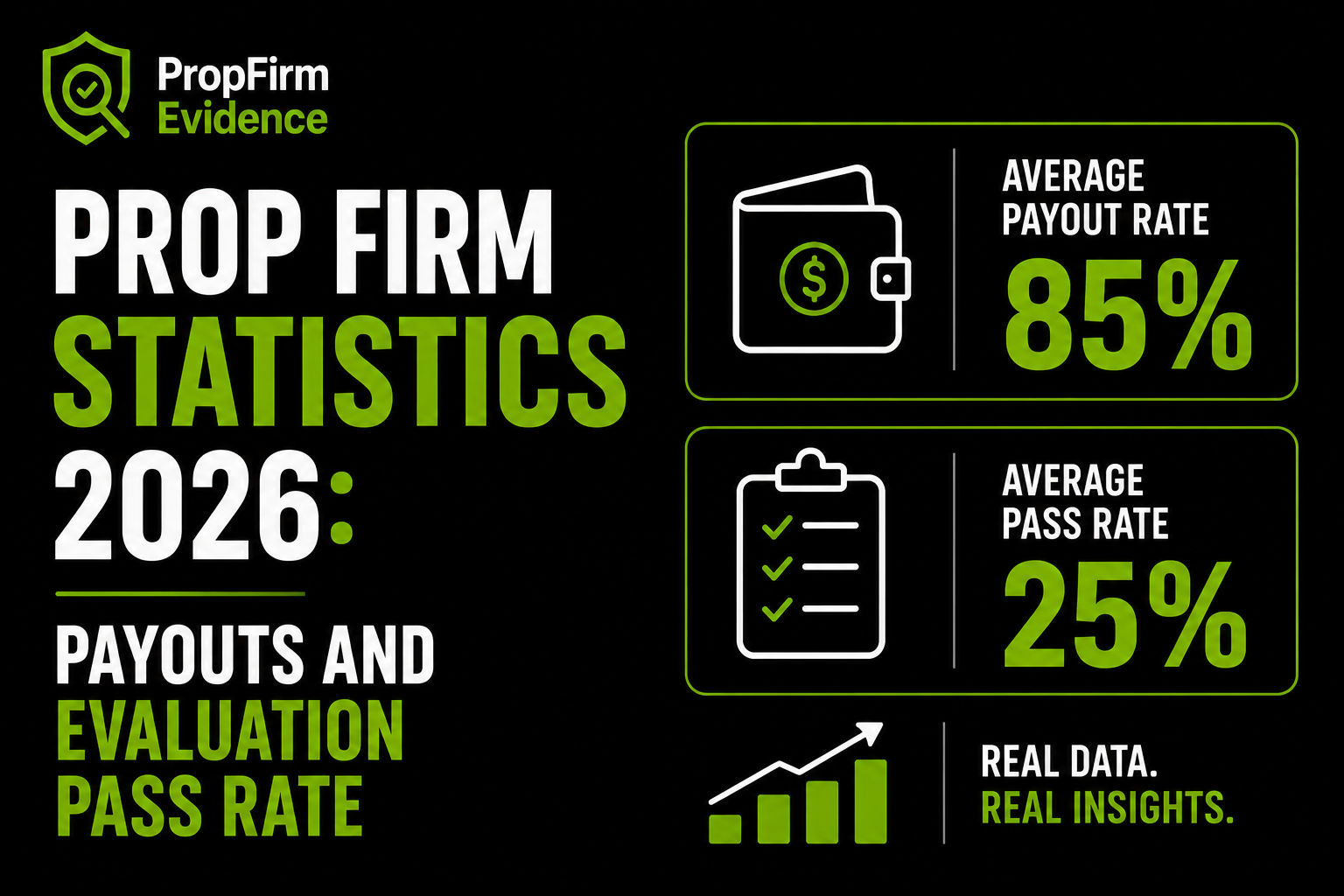
Prop Firm Statistics 2026: Payouts and Evaluation Pass Rate
A prop firm can look simple before you buy a trading challenge.
You see a large account, a clear target, a strong profit split, and a possible withdrawal at the end. The offer may also include discounts, fast processing, simple rules, and success stories from other traders.
That is the marketing version.
The real question is more practical.
How many traders pass?
How many reach funding?
How many actually see payouts?
And what can public data really tell you?
This guide explains prop firm statistics, pass rate data, evaluation rules, prop trading risks, funded account conditions, and firm transparency in 2026.
It is written for the trader who wants to compare firms properly before paying for a challenge.
Prop Firm Payout in 2026: What Traders Need to Know
A prop firm payout is the point where the model becomes real.
Passing a challenge matters, but it is not the final goal. The trader still has to follow the rules, protect the account, meet any minimum trading day requirement, request payment correctly, and pass the firm review.
That is why payout in 2026 should be judged by clarity, consistency, and evidence.
A firm may promote:
- Large account size
- Low challenge fees
- High profit split
- Fast payout
- Daily payouts
- Flexible trading conditions
- Simple targets
- Large total payout volume
These claims can be useful.
They are not enough on their own.
A trader needs to know how the payout process works, when the first payout becomes available, whether withdrawals are capped, and what can delay approval.
A firm actually pays reliably when traders can understand the route before they buy.
That does not mean every request is instant.
It means payouts are processed in a predictable way.
Prop Firm Statistics and Industry Data
Prop firm statistics help traders compare offers more carefully.
Good industry data can show how difficult a challenge is, how often traders reach funding, and how realistic the withdrawal path appears.
Useful data includes:
- Pass rate
- Evaluation pass rate
- Prop firm evaluation pass rates
- Number of traders who pass
- Number of funded traders
- Percentage of traders who receive payouts
- Average payout
- Average payout size
- Average monthly payout
- First payout timing
- Processing speed
- Total payouts
- Rule breach reasons
- Account closure reasons
The problem is that trading firms do not always report numbers in the same way.
One firm may show how many traders pass phase 1.
Another may show full challenge completion.
Another may only highlight successful funded traders.
Another may publish selected proof without showing wider payout data.
This is why industry data needs context.
One data point can help.
It is not enough to judge the whole firm.
Prop Firm Pass Rates, Evaluation Pass and Success Rates
A pass rate tells you how many traders complete a specific stage.
But the phrase can mean several things.
A firm may be referring to:
- First-attempt pass
- Phase 1 completion
- Phase 2 completion
- Full evaluation pass
- Funded conversion
- Percentage of traders who receive payments
These numbers are not the same.
A trader may pass phase 1, fail phase 2, buy another account, and still never reach funding.
This is why prop firm evaluation pass rates should be read carefully.
When firms report pass rates, ask:
- What stage is being measured?
- Does the number include repeat attempts?
- Does it include all account sizes?
- Does it include inactive accounts?
- Does it include traders who eventually receive payments?
- Is the reporting period clear?
Realistic pass rates help traders make better decisions.
Vague success rates do not.
Industry-Wide Pass Rate and Low Pass Claims
The industry-wide pass rate is usually low because prop firm challenges test more than market knowledge.
They test patience, risk control, emotional discipline, and rule awareness.
Many traders fail because they treat the challenge like a race. They focus on the profit target instead of protecting the account.
Common reasons traders fail include:
- Taking too much risk per trade
- Ignoring the daily loss limit
- Increasing position size too quickly
- Trading too often
- Chasing losses
- Breaking minimum trading rules
- Misunderstanding drawdown
- Trading restricted news events
- Forcing trades late in the challenge
A low pass number does not automatically mean the firm is unfair.
Sometimes it means traders are unprepared.
But a low pass number combined with unclear rules, poor support, and weak public data is a warning sign.
The better question is not only whether traders pass.
It is what happens to traders who pass.
Prop Firm Evaluation Rules Traders Must Check
A prop firm evaluation is not only a profit test.
It is a behaviour test.
The firm wants to see whether a trader can reach a profit target without taking unacceptable risk.
Before buying an evaluation, check:
- Profit target
- Daily loss limit
- Maximum drawdown
- Minimum trading day rule
- Consistency rule
- News trading rules
- Lot size or contract limits
- Platform conditions
- Copy trading rules
- Expert adviser rules
- Withdrawal eligibility after passing
The profit target gets the most attention.
The daily loss limit often causes more failures.
A trader can be profitable overall and still lose the account because one bad trading day breaks the rule.
The easiest-looking challenge is not always the best one.
The right account is the one that fits your method.
How to Pass a Prop Firm Without Gambling
To pass a prop firm, you need a plan that survives the rules.
The goal is not to pass quickly.
The goal is to pass without damaging your trading habits.
A practical plan includes:
- Fixed risk per trade
- Clear entry and exit rules
- Controlled position size
- A maximum number of trades per day
- A stop rule after losses
- A plan for slow market conditions
- No revenge trading
- No final-day gambling
- A review after each session
The trader who wants to pass prop firm evaluations should think in probabilities.
One trade should not decide the account.
If one loss can destroy the evaluation, the risk is too high.
A slower evaluation pass is usually better than a fast failure.
Prop Firm Trading and Funded Account Rules
Prop firm trading changes after the challenge.
A funded account is not a free pass.
It often has its own terms.
Before placing the first trade, a funded trader should read the funded agreement carefully.
Check:
- Payment eligibility
- First payout timing
- Profit split
- Maximum withdrawal per cycle
- Minimum trading rules
- KYC requirements
- Scaling rules
- Risk reviews
- Prohibited strategies
- Account breach conditions
The firm gives traders access to capital or simulated capital under specific terms.
Those terms matter.
If the trader treats the funded account like the challenge is over, they can lose the account quickly.
The first goal after funding is not to rush withdrawal.
The first goal is to stay eligible.
Why Traders Pass Evaluations but Miss Payout
Some traders pass evaluations and still never receive payments.
This surprises newer traders, but it is common.
A trader may pass the test, reach funding, and then lose access before withdrawal because of:
- A daily loss limit breach
- A consistency rule breach
- Aggressive trading before the first payout
- Failed verification
- Restricted news trading
- A prohibited strategy
- Misunderstood withdrawal dates
- Rules broken after requesting money
This is why evaluation pass data is not enough.
You also need to know how many traders who pass actually receive payouts.
A firm can have higher pass rates and still have weak conversion after funding.
Another firm can have stricter rules but stronger reliability for disciplined traders.
The funded stage is where the full system is tested.
Payout Process Explained Before Funding
The payout process should be clear before the trader buys the challenge.
A good process explains:
- When eligibility begins
- How the request is made
- How long review takes
- Whether KYC is required
- How the profit split is calculated
- Whether there is a minimum payout
- Whether there is a maximum withdrawal
- What can delay approval
- What can cancel the request
A trader should not need to contact support several times to understand basic withdrawal rules.
If the payout process is unclear before purchase, it may be worse after funding.
Clear rules reduce pressure.
The trader can focus on execution instead of guessing how the firm will respond.
Payout Structures, Profit Split and Early Payouts
Payout structures vary widely.
Some firms offer an 80% profit split. Others advertise 90% or more. Some increase the split after scaling. Some limit early payouts.
A high profit split is useful only when the withdrawal rules are fair.
A 90% split with confusing terms may be worse than an 80% split with clear rules and consistent payouts.
When comparing structures, check:
- First withdrawal timing
- Monthly payout rules
- Whether early payouts are capped
- Whether initial payouts require extra review
- Profit split calculation
- Minimum withdrawal amount
- Maximum withdrawal amount
- Whether withdrawals affect drawdown
- Whether payment resets account metrics
The best structure is easy to understand.
A trader should know what happens before requesting money.
Average Payout, Total Payouts and Total Payout Volume
Average payout data can be helpful, but it can also mislead.
A high average payout may be influenced by a small number of very successful traders.
Average monthly payout may not show the typical trader experience.
Total payouts can also be incomplete.
A firm may promote a large total payout volume, but that does not tell you:
- How many traders requested money
- How many requests were approved
- How many were delayed
- How many were rejected
- How long review took
- Whether the number includes all account types
For example, a firm may advertise 56 million in payouts.
That sounds strong.
But the trader still needs context.
Does the figure include all programmes?
Does it show how many traders were paid?
Does it include repeat withdrawals from the same traders?
Large figures can be useful.
Transparent payout data is better.
Fast Payout, Faster Payouts and Daily Payouts
Fast payout claims are popular because traders want quick access to profits.
That is understandable.
But faster payouts are not always better if the rules are unclear.
Some firms advertise daily payouts. Others let traders unlock daily payouts after meeting specific conditions. Some use weekly or bi-weekly cycles. Others have a monthly payout model.
None of these structures is automatically good or bad.
What matters is clarity.
A firm should explain:
- When daily payouts apply
- Whether the trader must complete a minimum number of days
- Whether withdrawals are reviewed manually
- Whether there are caps
- Whether payout speed changes after the first withdrawal
Rigid payout windows can be acceptable when they are explained clearly.
Unclear windows create frustration and mistrust.
Public Proof and Whether Traders Actually See Payouts
Public proof can help, but one screenshot is not enough.
One screenshot only proves that at least one payout happened.
It does not prove that the firm pays consistently.
A better review looks at:
- Multiple recent payment examples
- Public withdrawal rules
- Independent trader feedback
- Community discussions
- Review patterns
- Firm communication
- Rule updates
- Long-term evidence
Some traders ask whether they will ever see payouts.
That depends on two things.
The first is whether the firm actually pays.
The second is whether the trader can follow the rules long enough to qualify.
A firm actually pays reliably when withdrawals are documented, rules are clear, and traders report successful payments over time.
Firm Evaluations and Evaluating Prop Firms
Firm evaluations should not only compare prices.
They should compare trust.
Evaluating prop firms properly means looking at the whole operating model.
Review:
- Evaluation rules
- Pass rate data
- Payment rules
- Funded account conditions
- Trader complaints
- Support quality
- Rule stability
- Public payment history
- Company communication
A firm offering large accounts and discounts can still be a poor choice if withdrawal terms are unclear.
Good firm evaluations help traders understand both strengths and weaknesses.
The best review is not the one that says every firm is good.
It is the one that explains the trade-offs.
Firm Transparency and Public Data
Firm transparency is one of the strongest signs of operational quality.
A transparent firm explains important conditions before purchase.
It does not hide rules behind vague wording.
It updates terms clearly.
It answers common questions.
It makes risk limits easy to understand.
Good transparency includes:
- Clear challenge rules
- Clear funded account rules
- Clear withdrawal terms
- Clear breach examples
- Clear support channels
- Clear updates when rules change
Industry statistics reveal only part of the picture.
Transparency helps fill the gap.
If a firm does not publish enough information, the trader has to carry more uncertainty.
Choosing a Firm That Matches Your Trading
Choosing a firm should start with your own method.
Not the discount.
Not the account size.
Not social media hype.
A scalper needs execution quality, low costs, and rules that do not punish frequent trading.
A swing trader needs holding flexibility.
A news trader needs clear news permissions.
A futures trader needs contract limits, platform access, and drawdown rules that make sense.
A forex trader needs to check spreads, commissions, leverage, and weekend holding.
Before choosing a firm, ask:
- Is this a firm that matches your trading?
- Can I trade normally within the rules?
- Can I meet the minimum requirements naturally?
- Can I wait for the withdrawal cycle?
- Does the firm allow my strategy?
- Can I stay disciplined during the challenge?
A firm that matches your trading is usually better than a firm with the loudest offer.
Best Prop Firms and Top Prop Comparison
The best prop firms are not always the firms with the biggest accounts.
A top prop brand may still be a poor fit for your strategy.
A fair comparison should include:
- Pass rate information
- Payment reliability
- Withdrawal process
- Profit split
- Evaluation rules
- Challenge fees
- Minimum trading rules
- Funded account terms
- Support quality
- Public complaints
- Firm transparency
Best prop lists can help with research.
They should not replace your own checks.
A trader should not choose a firm because it appears on a ranking.
They should choose the right firm because the rules match their trading.
Apex Trader Funding and Futures Prop Firm Data
Apex Trader Funding is often discussed in the futures funding space.
For futures traders, the questions are different from forex or CFD accounts.
Check:
- Contract limits
- Trailing drawdown
- Consistency rule
- Minimum trading days
- Payment eligibility
- Platform fees
- Reset rules
- Scaling rules
If you see a claim such as a pass rate of 10.42, check the source and context.
Does it cover one account type?
Does it include repeat attempts?
Does it include traders who receive payouts?
Does it include inactive accounts?
Is it recent?
A precise number can look reliable, but it still needs context.
This applies to Apex Trader Funding and every other firm.
Numbers only help when the measurement is clear.
Prop Trading Industry, Retail Prop and Prop Fintech
Retail prop has grown quickly.
More traders now understand funding models, challenges, accounts, and withdrawal rules.
This growth has also created more competition among firms.
Some firms operate like traditional trading firms.
Others look more like prop fintech platforms, with dashboards, automated rules, account scaling, and quick onboarding.
The prop trading industry is still changing.
Growth creates opportunity, but it also creates pressure.
More traders mean more support requests, more payment reviews, more disputes, and more scrutiny.
A firm takes on responsibility when it sells an evaluation.
It should be ready to explain its rules, manage trader expectations, and process withdrawals properly.
Future of Prop and Better Industry Data
The future of prop will likely depend on transparency.
Traders want clearer pass rates, stronger payout data, and fewer vague rules.
In the days leading up to 2026, traders became more aware of the difference between marketing claims and real operational evidence.
If scrutiny continues and competition grows, the rate increases significantly for firms that publish clearer statistics and stronger documentation.
The future may favour firms that publish:
- Realistic pass rates
- Evaluation pass data
- Funded trader statistics
- Withdrawal approval data
- Average payout size
- Support response standards
- Rule breach summaries
- Public rule updates
This would help traders compare firms more fairly.
It would also help serious firms stand out.
What Public Data Can and Cannot Prove
Public data can help traders make better decisions.
But it cannot prove everything.
It can show:
- Whether a firm publishes rules clearly
- Whether traders share payment proof
- Whether complaints repeat
- Whether support communicates well
- Whether rules change often
- Whether firms report pass rates
It cannot show every internal review, every rejected withdrawal, or every account breach.
That is why traders should avoid relying on one source.
Use official terms, public feedback, payment proof, and community patterns together.
Good research looks for consistency.
Common Mistakes Prop Firm Traders Make
Many prop firm traders fail because they choose the wrong account or misunderstand the rules.
Common mistakes include:
- Buying because of prop firm discounts
- Ignoring the daily loss limit
- Chasing a high profit target too quickly
- Trading too large during the evaluation
- Ignoring minimum trading rules
- Thinking funding guarantees payment
- Trusting one screenshot
- Not checking withdrawal eligibility
- Not reading the full agreement
- Choosing a firm based on hype
Prop traders need discipline before they need a bigger account.
A large funded account is useful only if the trader can keep it.
How to Improve Your Chances of Reaching Payout
A trader can improve their odds by slowing down.
Use a process that reduces emotional decisions.
Before starting, define:
- Maximum risk per trade
- Maximum loss per day
- Maximum trades per session
- Allowed setups
- Stop rules
- Review process
- Withdrawal rules
- Account breach conditions
During the challenge, protect the account first.
After funding, protect eligibility first.
The trader who treats each trading day as part of a longer process is more likely to survive.
This does not guarantee payment.
It does help traders avoid avoidable mistakes.
Final Thoughts on Payouts 2026 and Prop Firm Trading
Payouts 2026 should be judged by evidence, not hype.
A large account is not enough.
A low challenge fee is not enough.
A high profit split is not enough.
A serious trader needs clear evaluation rules, fair risk limits, useful public data, and a payout process that is easy to understand.
The best firms explain their terms clearly, publish useful information, process withdrawals consistently, and give traders a fair structure to work within.
If you want to pass prop firm rules, focus on discipline before speed.
Read the rules. Check the payment structure. Compare pass rate claims carefully. Review public data. Choose a firm that matches your trading.
The trader who lasts long enough to receive a payout usually does not rush.
They manage risk, protect the account, and treat the process like a business.