
When your strategy isn’t the problem: knowing when to bring in a performance coach
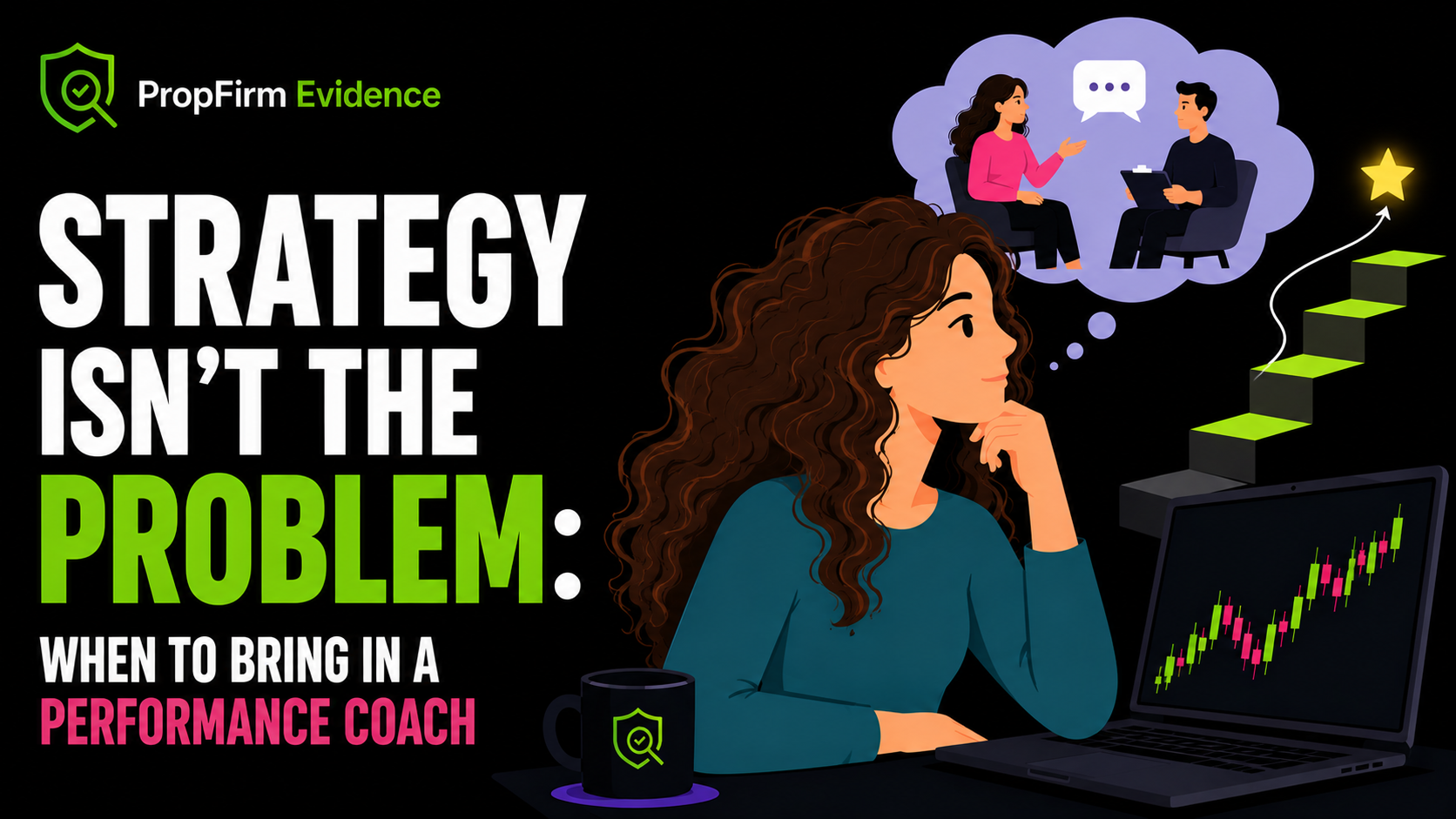
A trader can have a clearly defined strategy, encouraging backtest results and a process that appears workable in live conditions, yet still execute it inconsistently.
When a persistent gap develops between what the trading plan requires and what the trader actually does, the problem may no longer be purely technical.
That is one situation where performance coaching can become relevant.
The objective is not to replace the trading strategy. It is to examine the behaviours, habits and decision patterns that may be interfering with the trader’s ability to execute that strategy consistently.
Coach and Mentor Are Not the Same Role
The terms coach and mentor are often used interchangeably, but they can describe different forms of support.
A trading mentor may help with areas such as:
Understanding market mechanics
Developing or reviewing a strategy
Risk management
Trade review
Avoiding common technical mistakes
A performance coach usually works on a different layer.
Rather than simply telling the trader what trade to take or which strategy to use, coaching may involve structured questioning, goal setting, behavioural review and accountability.
The focus is often on questions such as:
Why does this mistake keep happening?
What happens immediately before the behaviour appears?
What conditions make execution better or worse?
What practical rule could reduce the likelihood of repeating it?
A good coaching relationship should help the trader understand and improve their own decision process rather than create permanent dependence on someone else making decisions for them.
Coaching Is Not Only for Traders Who Are Struggling
Performance coaching does not have to begin only after something has gone seriously wrong.
A trader who is already performing reasonably well may still want to improve areas such as:
Consistency
Decision-making under pressure
Preparation
Review habits
Risk discipline
Adaptation to larger stakes
Maintaining boundaries between trading and the rest of life
In that sense, coaching can be developmental as well as corrective.
When a Performance Coach May Be Useful
Repeating the Same Mistake
Knowing that a mistake exists does not automatically stop it from happening again.
A trader may repeatedly:
Enter too early
Move stop losses
Increase size after losses
Close winners prematurely
Ignore trading-hour limits
If the behaviour continues despite repeated review, an outside perspective may help identify the conditions or triggers that appear before it.
The value of coaching here is not that the coach necessarily knows the cause in advance.
It is that structured questioning and observation can help make a recurring pattern easier to see and test.
Emotional Interference
Fear, frustration, excitement and overconfidence can all influence financial decisions.
The goal of performance coaching should not be to eliminate emotion.
A more realistic objective is to help the trader recognise emotional states earlier and build responses that reduce their ability to override predefined rules.
For example:
What happens when a position approaches the stop?
What thoughts appear after consecutive losses?
What changes after an unusually profitable session?
Which emotional states are most associated with rule violations?
Once those relationships become clearer, specific behavioural safeguards can be tested.
Difficulty Maintaining Discipline
Discipline is often discussed as though it were simply a personality trait.
In practice, disciplined behaviour can also be supported by structure.
A coach may help a trader develop mechanisms such as:
Pre-trade checklists
Trading-hour boundaries
Maximum trade counts
Personal daily loss limits
Mandatory review after rule violations
Cooling-off periods after losses
The coach does not remove responsibility from the trader.
The trader still decides whether the rules are followed.
The purpose is to make the desired behaviour clearer, measurable and easier to review.
When the Problem Is Difficult to Define
Sometimes a trader knows that performance is deteriorating but cannot clearly identify why.
The strategy appears unchanged.
The market does not appear dramatically different.
Yet execution has become inconsistent.
An outside perspective can be useful because explaining the process to another person often forces vague concerns into more specific questions.
For example:
Is the problem the strategy?
Is position sizing too aggressive?
Has trade frequency increased?
Are losses being managed differently?
Has confidence changed?
Are outside pressures affecting concentration?
Defining the problem correctly matters because different problems require different solutions.
Overtrading
Overtrading can take several forms.
A trader may take too many marginal setups.
They may continue trading after their planned session has ended.
They may increase activity after a loss in an attempt to recover quickly.
Or they may trade simply because remaining inactive feels uncomfortable.
A performance coach can help convert the problem into something measurable.
For example:
Maximum trades per session
Minimum setup score before entry
Mandatory break after a certain number of losses
No trading outside predefined hours
Once the behaviour has a measurable boundary, improvement becomes easier to evaluate.
Fear of Losing
Fear of loss can appear in several different ways.
A trader may hesitate before valid entries.
They may reduce size unexpectedly.
They may close profitable trades too early.
Or they may avoid trading altogether after a difficult period.
One useful coaching question is:
What does a losing trade mean to you?
For one trader, it may simply represent normal strategy variance.
For another, the same loss may feel like evidence that they are failing or moving further away from an important financial goal.
Understanding that interpretation can help explain why similar losses produce very different behavioural responses.
The objective is not to convince the trader that losses do not matter.
It is to distinguish a controlled loss within the trading plan from an execution failure.
Burnout and Fading Motivation
Periods of reduced motivation can also affect trading performance.
A trader may become increasingly disengaged from preparation, journaling or review while continuing to place trades.
Coaching can help reassess:
Whether the current goal is still realistic
Whether trading frequency is sustainable
Whether expectations have become unrealistic
Whether adequate recovery time exists
Whether the trader is still following a process they actually believe in
Sometimes the useful intervention is not more motivation.
It is reducing unnecessary pressure and rebuilding a sustainable structure.
Confidence After a Losing Period
A losing sequence can reduce confidence even when it remains within the historical behaviour of the strategy.
This creates an important distinction:
Has the strategy changed, or has confidence changed?
A coach can help the trader return to the evidence:
Is the drawdown unusual?
Were the rules followed?
Has expectancy materially changed?
Is the trader reacting to the last few trades rather than the larger sample?
Confidence is most useful when it is connected to evidence rather than simply rebuilt through positive thinking.
Moving Up in Stakes
A strategy may feel very different when the financial consequences increase.
A trader who executes comfortably on a small account may hesitate or interfere with trades after moving to larger exposure.
The technical setup may be identical.
The psychological meaning of the loss may not be.
Coaching can help the trader design a more controlled transition, potentially involving:
Gradual increases in size
Predefined scaling criteria
Tracking rule adherence as size increases
Reducing exposure again if execution deteriorates
The objective is not simply to tolerate more pressure.
It is to determine whether the trader can maintain the same quality of execution as financial exposure changes.
No Trading Plan or Unrealistic Goals
Sometimes the apparent psychological problem begins with an operational one.
A trader cannot consistently follow a plan that has never been clearly defined.
Likewise, unrealistic goals can create unnecessary pressure.
A performance coach may help turn vague objectives into clearer ones.
A framework such as SMART — specific, measurable, achievable, relevant and time-bound — can sometimes be useful for this purpose.
But trading goals need particular care because traders do not directly control market returns.
Process goals may therefore be more useful than demanding a fixed financial result within an arbitrary period.
For example:
Complete every journal entry this month.
Take only setups that meet all required conditions.
Keep every trade within predefined risk.
Review all rule violations weekly.
These are behaviours the trader can control directly.
What a Performance Coach Cannot Do
Performance coaching has limits.
A coach cannot create a profitable strategy simply through mindset work.
A coach cannot guarantee trading success.
A coach cannot remove uncertainty from financial markets.
And a coach should not be treated as a substitute for appropriately qualified medical or mental-health care where clinical support is needed.
This distinction is especially important when problems involve significant anxiety, depression, addiction-like behaviour, severe financial distress or broader difficulties extending well beyond trading performance.
Performance coaching is primarily about behaviour, execution, goals and performance processes.
Clinical mental-health treatment is a different professional role.
How to Evaluate a Trading Performance Coach
The word “coach” is not itself evidence of expertise.
Before working with someone, consider asking:
What exactly do they coach?
What qualifications or relevant professional experience do they have?
Do they clearly explain the limits of their role?
Do they promise specific financial results?
Do they distinguish performance coaching from therapy or financial advice?
How will progress actually be measured?
Will they review behaviour and process, or simply provide motivational conversations?
Are costs, commitments and cancellation terms transparent?
Be particularly cautious of anyone presenting coaching as a guaranteed route to profitability.
No legitimate performance process can remove the uncertainty inherent in trading.
A Simple Decision Test
A trader considering coaching might ask:
Do I have a defined strategy?
Has the strategy been tested across a meaningful sample?
Do I understand my risk?
Do I know what correct execution looks like?
Is my actual behaviour repeatedly departing from those rules?
Have I identified a pattern I cannot seem to change alone?
Would an independent perspective help me measure and challenge that behaviour?
If the answers point toward an execution problem rather than a strategy problem, performance coaching may be worth considering.
What This Comes Down To
Strategy and execution are different problems. A trader can understand the technical process while still struggling to follow it consistently.
Coaches and mentors can serve different purposes. Mentoring often focuses more heavily on knowledge and experience, while coaching can focus on behaviour, goals and performance processes.
Coaching is not only remedial. It can also be used to refine an already functional process.
Recurring mistakes deserve investigation. If the same behaviour continues despite awareness, structured outside review may help identify what is maintaining it.
Performance should be measurable. A coaching relationship should eventually produce observable changes in behaviour, process or execution — not simply better-sounding conversations.
Coaching has professional limits. It cannot replace a tested strategy, guarantee profitability or substitute for qualified mental-health treatment where that is required.
Choose the coach carefully. Clear boundaries, relevant competence, transparent claims and measurable objectives matter more than the title “performance coach”.
Conclusion
Bringing in a performance coach does not necessarily mean a trader has failed.
Sometimes it simply means the technical process is already developed enough that the next problem has become behavioural.
The useful question is not:
“Do I need someone to tell me how to trade?”
It is:
“Is there a persistent gap between what I know I should do and what I repeatedly do under pressure?”
If that gap remains after journaling, review and deliberate attempts to change it, an appropriately qualified outside perspective may help.
The strategy still needs evidence.
The risk still needs control.
The trader still makes the final decisions.
Performance coaching is simply one possible tool for improving the part of the system that sits between the trading rules and their actual execution.