
What happens if you lose money on a funded account?
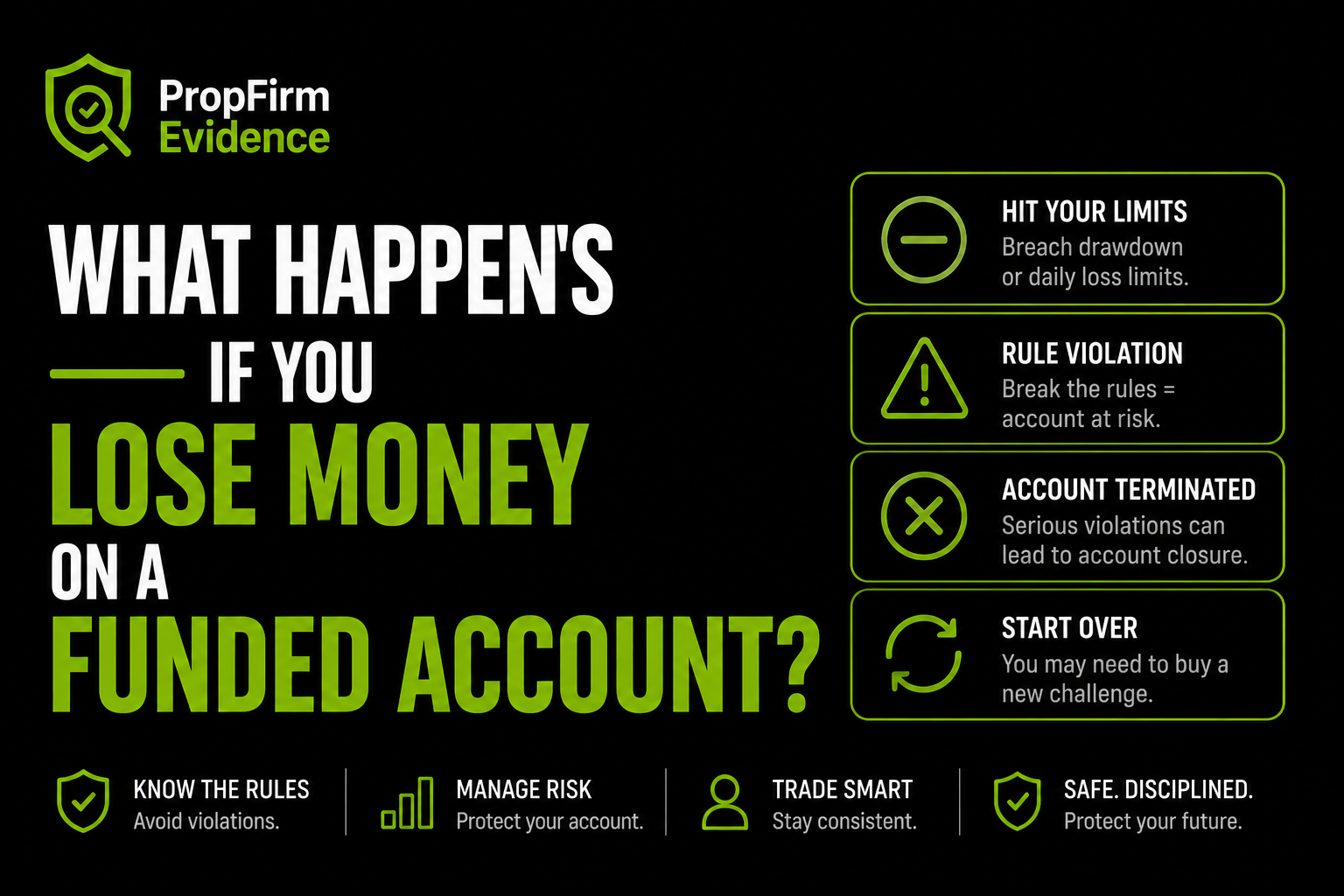
Many traders worry about what happens if you lose money on a funded account.
It is one of the most common questions before joining a prop firm, especially for anyone who is new to prop trading, forex, or funded trading programmes.
The concern is understandable.
You may be given access to a large funded account, but what if a trade goes wrong? What if you lose money on a funded account? Do you owe the prop firm money? Can the company ask you to pay a prop firm back? Does losing money mean immediate account closure?
In most cases, no.
A trader normally does not owe the prop firm money for normal trading losses inside the agreed limits. The usual consequence is different. If you break prop firm rules, exceed drawdown limits, or create an account breach, the account is typically closed.
That is the key distinction.
Losing money is part of trading.
A breach is a rule violation.
Understanding that difference helps you protect your funded account, manage risk, and avoid losing a funded account because of avoidable mistakes.
How a Funded Account Works
A funded account allows a trader to access trading capital through a prop firm after meeting certain conditions.
Usually, the process starts with an evaluation account. The trader must reach a profit target while following the firm’s rules. If they pass, they may receive access to the funded account and become eligible for a profit split.
The account may be live, simulated, or based on simulated trading results, depending on the company’s model.
This is important.
Not every funded account works the same way. Some proprietary trading firms operate through simulated trading environments. Others may use live capital for certain traders or account types. Some offer demo accounts during the evaluation stage and a simulated account after passing.
You should always read the agreement before you start your funded trading journey.
A funded account is not the same as personal trading.
In personal trading, you set your own rules. You choose how much to risk, when to hold positions, whether to trade news, and how to manage drawdown.
With a funded account, the prop firm sets the rules.
That means your job is not only to make profitable trades. Your job is to trade inside the firm’s limits.
What Happens If You Lose Money on a Funded Account?
If you lose money on a funded account, the outcome depends on whether the loss stays within the allowed limits.
A normal losing trade does not usually cause a problem.
For example, a trader might risk 0.5% on a valid setup, use a stop-loss, follow the plan, and still lose. That is normal. No account breach has happened if the loss remains within the daily and overall limits.
The trader can usually continue trading.
The problem starts when the loss breaks a rule.
If the account balance or account equity falls below the firm’s maximum permitted level, the funded account may be closed. If the trader breaks news trading rules, copy trading rules, position limits, or other restrictions, the same thing can happen.
So the answer is simple:
Losing money does not always end the account.
Breaching the rules can.
Do You Owe the Prop Firm Money?
Most traders do not owe the prop firm money if they lose money on a funded account.
This is one of the biggest misconceptions in prop trading.
A funded account is usually not a personal loan. You are not normally borrowing money in your own name. If you lose access because of a rule violation, the usual result is account closure or account termination, not a demand for repayment.
In most cases, the trader loses:
- The evaluation fee.
- The account access.
- Any unpaid profit split if payout rules were not met.
- The opportunity to continue trading that account.
That does not usually mean you must pay a prop firm back for trading losses.
Still, you should never assume all firms work the same way.
Read the contract, risk disclosure, terms of service, refund policy, and payout rules before buying an evaluation account. If the wording is unclear, ask the trading firm directly.
Losing Money vs an Account Breach
Many beginners confuse losing money with breaching a funded account.
They are not the same.
Losing Money
Losing money is part of trading.
Every trader has losing trades. Even skilled traders have losing days, losing weeks, and periods of drawdown.
This is normal in forex trading, indices, commodities, futures, crypto, day trading, and swing trading.
A trader can lose money on a funded account and still remain fully compliant.
That happens when:
- The trade follows the plan.
- Risk is controlled.
- The stop-loss is respected.
- Position size is sensible.
- The loss stays inside account rules.
- The trader does not chase the loss.
These are normal trading losses.
They are not pleasant, but they are expected.
Account Breach
An account breach happens when the trader breaks one or more rules attached to the funded account.
This may involve losing too much, but not always.
A breach can also happen if the trader uses a prohibited strategy, holds positions when not allowed, trades during restricted news, or breaks the firm’s platform rules.
Once there is a breach, the firm may suspend, close, or terminate the account.
That is why funded traders must know the rules before placing the first trade.
What Is a Breach in Prop Trading?
A breach is a violation of the agreement between the trader and the firm.
The prop firm creates limits to control risk. If the trader breaks those limits, the trader’s account may lose active status.
Different firms use different labels.
You may see terms such as:
- Account breach.
- Hard breach.
- Soft breach.
- Account closure.
- Account termination.
- Failed account.
- Suspended account.
The exact wording may vary, but the practical result is often similar.
The trader may lose access to the funded account.
A hard breach is usually final. The account is closed immediately.
A soft breach may be less severe. It may trigger a warning, pause, or temporary restriction. But you should not rely on getting a second chance. Some firms apply rules automatically.
Common Prop Firm Rules That Lead to Account Closure
Every prop firm has its own rules, but many use similar risk controls.
These rules are not minor details.
They decide whether you keep the account or lose it.
Maximum Daily Loss
The maximum daily loss rule controls how much a trader can lose in one trading day.
This is one of the most important risk management rules.
For example, if the daily limit is 5%, the account may breach if losses reach that level.
But the calculation method matters.
Some firms use starting balance. Others use equity. Some include floating losses. Some reset the day at a specific server time.
A trader must know exactly how the firm calculates this rule.
Otherwise, you may think you are safe while the platform records a breach.
Maximum Overall Loss
The maximum overall loss rule limits how far the account can fall from its starting value or high-water mark.
This is often the rule that causes losing a funded account.
If the maximum loss is 10%, the funded account may close when the account balance or equity reaches that limit.
Some firms use static drawdown.
Others use trailing drawdown.
This difference matters because a trailing rule can move as the account grows. A trader may protect profit poorly, give too much back, and then breach even though the account was once in profit.
Position Size Limits
Some prop trading firms restrict lot size, exposure, open positions, or risk per idea.
This prevents traders from placing oversized trades that could damage the account quickly.
A trader may feel confident in a setup, but confidence does not remove risk.
Position size should be based on the account size, stop distance, and risk rules, not emotion.
News Trading Rules
News trading is restricted by many firms.
This may include central bank decisions, inflation data, employment reports, interest rate announcements, or other high-impact events.
Some firms ban opening or closing trades around news. Others only restrict certain instruments. Some allow news trading completely.
You must check.
A profitable trade can still cause an account breach if it breaks the news policy.
That surprises many traders, but the firm will usually follow its written rules.
Holding Trades Overnight or Over the Weekend
Some firms allow overnight positions. Others do not.
Some allow swing trading. Others are designed mainly for intraday strategies.
Holding a position outside the allowed period can lead to account closure, even if the position is profitable.
If your method requires overnight holding, make sure the account type supports it before you buy.
Copy Trading and Trade Copier Rules
Copy trading can be a serious issue in funded trading.
Some firms allow trade copiers under certain conditions. Others ban them or restrict them heavily.
Problems may appear when several accounts show identical entries, identical exits, or suspicious execution patterns.
The firm may treat this as account abuse.
If you use signals, managed accounts, trade copying software, or mirrored strategies, ask for permission first.
Expert Advisors and Automated Strategies
Some firms allow Expert Advisors.
Others restrict automated systems, especially if they involve latency arbitrage, high-frequency execution, grid systems, martingale strategies, tick scalping, or platform abuse.
Just because a system works on demo accounts does not mean it is allowed by the prop firm.
Always check the rules before using automation.
Consequences of Losing Money on a Funded Account
The consequences of losing money depend on the situation.
If the Loss Is Within the Rules
If the loss is within the firm’s limits, the trader usually continues.
The account balance is lower, but the funded account remains active. The trader reviews the result, follows the plan, and waits for the next valid setup.
There may be no formal consequence.
This is normal trading.
If the Daily Limit Is Broken
If the daily limit is broken, the account may close or become suspended.
The firm may classify this as a hard breach or soft breach, depending on its policy.
Once the limit is broken, the quality of the next trade does not matter.
The rule has already been violated.
If the Overall Drawdown Limit Is Broken
If the trader exceeds the maximum overall loss, the account is typically closed.
This is usually one of the clearest rules in a funded account.
The firm sets a maximum permitted loss. If the trader passes that point, the account closes.
This may happen through one large position or through a series of smaller trading losses.
If Other Rules Are Broken
An account breach can also happen without a large financial loss.
For example, a trader may break account rules by trading restricted news, using a banned Expert Advisor, copying trades without approval, or violating platform policies.
In these cases, the firm may close the account even if the trading performance was profitable.
That can feel unfair to the trader, but the firm may still be acting under its rules.
Why Risk Management Matters More Than Profit
Many traders enter funded trading with the wrong focus.
They want to make as much money as possible quickly.
That mindset is dangerous.
The first goal is not profit.
The first goal is survival.
Risk management keeps the trader inside the rules long enough for a genuine edge to show. Without it, even a strong strategy can fail because one emotional session causes account closure.
Good risk management means knowing:
- How much to risk per trade.
- When to stop for the day.
- Which setups to avoid.
- How to reduce size during drawdown.
- How to protect the account during volatility.
- When not to trade.
A funded trader should never rely on hope.
The risk must be defined before entering a trade.
How to Manage Risk on a Funded Account
A trader who wants to keep trading must manage risk consistently.
This is not complicated, but it does require discipline.
Risk Less Than the Maximum Allowed
Do not trade close to the firm’s limits.
If the daily loss limit is 5%, that does not mean you should risk 2% or 3% on one position.
A few losing trades could put the account in danger.
Many funded traders prefer smaller risk, such as 0.25% to 0.5% per trade, depending on the strategy and account rules.
This gives the trader room to handle normal trading losses without panic.
Use a Personal Daily Stop
The firm has a daily loss limit.
You should have your own stricter limit.
For example, if the firm allows 5%, you might stop at 2%.
This helps prevent emotional trading after a difficult session.
When the personal limit is reached, stop trading.
Do not debate it.
Respect the Stop-Loss
A stop-loss protects the account when the trade idea is wrong.
It should be planned before entry.
Moving the stop because you do not want to accept the loss is dangerous. It can turn a normal loss into an account loss.
The stop-loss is not a suggestion.
It is part of the trade plan.
Adjust Position Size Properly
Position size should be based on risk, not confidence.
A trader can be confident and still be wrong.
Before entering a position, calculate the distance to the stop, the amount you are willing to risk, and the effect on the account if the setup fails.
This helps prevent oversized losses.
Avoid Revenge Trading
Revenge trading is one of the fastest ways to lose access to the funded account.
It happens when a trader tries to win back losses immediately.
The next setup may be weak. The risk may be too large. The trader may ignore the plan because the goal is emotional relief, not good execution.
If you feel desperate to recover, stop.
That is not the right state for trading.
Keep a Trading Journal
A trading journal helps you see patterns.
Do not only record entry, exit, and result.
Record behaviour.
Include:
- The reason for the trade.
- The setup quality.
- Position size.
- Risk amount.
- Emotional state.
- Whether you followed the plan.
- Any rule mistakes.
- Lessons for the next session.
Over time, this shows whether the problem is the strategy, execution, or emotion.
That can improve trading performance more than simply taking more trades.
Normal Trading Losses vs Rule Violations
A normal loss is part of the process.
A rule violation is different.
Normal Trading Losses
Normal trading losses usually happen when the trader follows the plan, uses correct size, respects the stop, and remains inside the limits.
These losses are not a sign that the account is in immediate danger.
They are simply part of trading.
Rule Violations
Rule violations happen when the trader breaks the framework.
This might include exceeding drawdown, ignoring risk limits, trading restricted events, using a banned method, or breaking account rules.
These are the losses that lead to account closure.
The difference is behaviour.
A disciplined trader can handle losing trades.
An undisciplined trader turns losing trades into bigger problems.
Why Traders Lose Funded Accounts
Most traders do not lose funded accounts because of one planned loss.
They lose them because of poor behaviour under pressure.
Overtrading
Overtrading means taking too many positions without enough quality.
It often comes from boredom, frustration, or pressure to make money.
More trades do not always mean more opportunity.
They often mean more mistakes.
Increasing Size After Losses
Some traders increase size after losing money.
They want to recover quickly.
This is dangerous because one more loss can cause serious damage.
A better approach is to reduce risk after losses, not increase it.
Ignoring Market Conditions
Not every strategy works in every environment.
Fast markets, low liquidity, major news, and unusual volatility can all affect results.
If conditions do not suit your method, wait.
Forcing a setup because you want action is not professional trading.
Not Reading the Rules
Some account breaches happen because the trader did not understand the rules.
This is avoidable.
Before you place a trade, you should know:
- Daily loss calculation.
- Overall drawdown calculation.
- News restrictions.
- Holding rules.
- Copy trading policy.
- Expert Advisor rules.
- Payout conditions.
- Inactivity rules.
- Lot size limits.
Do not learn the rules after the account closes.
What Happens When You Breach a Funded Account?
What happens when you breach an account depends on the firm.
The account may be closed immediately. It may be suspended for review. It may be marked as failed. Existing platform access may be removed.
If the breach is a simple drawdown violation, the process may be automatic.
If the issue involves prohibited trading activities, copy trading, suspicious execution, or identity concerns, the firm may investigate.
The trader may or may not be allowed to purchase a new account.
This depends on the reason for the breach and the firm’s policy.
Account Closure, Suspension and Termination
These terms are often used in funded trading, but they are not always identical.
Account Closure
Account closure means the account is no longer active.
The trader cannot continue trading that account.
This usually happens after a hard rule violation.
Account Suspension
If an account is suspended, the firm may be reviewing activity or waiting for more information.
The trader may temporarily lose access while the issue is checked.
Account Termination
Account termination usually means the agreement has ended.
This can affect platform access, payout eligibility, and future participation with the firm.
Always check the specific wording in the firm’s terms.
Can You Get Funded Again After Losing a Funded Account?
In many cases, yes.
Losing a funded account does not always mean you are banned.
Many firms allow traders to buy another evaluation account and try again. Some offer resets or discounted retries. Others require you to start from the beginning.
However, this depends on why the account was lost.
A simple drawdown breach may not stop you from trying again.
Serious misconduct, false information, multiple account abuse, or prohibited trading activities may lead to a ban.
If you want another chance, treat the process professionally.
Review what happened, correct the mistake, and do not repeat the same behaviour.
Can You Withdraw Profits After Losing Money?
You can usually withdraw profits only if you meet the firm’s payout rules.
This may include minimum trading days, profit thresholds, verification checks, consistency rules, and no active violations.
If you lose money but remain inside the rules, a future payout may still be possible.
If the account closes before the payout is approved, the trader may lose the right to withdraw.
This is why protecting the account matters even after becoming profitable.
A trader should not take unnecessary risks just because the account is in profit.
What If the Account Closes by Mistake?
Sometimes a trader believes the account closes unfairly.
This can happen because of platform issues, unclear calculations, news timing, spread widening, or disagreement over rule interpretation.
If you believe there has been an unfair account closure, do not react emotionally.
Collect evidence first.
You may need:
- Account number.
- Trade history.
- Time stamps.
- Screenshots.
- Platform logs.
- Relevant rules.
- Support messages.
- A clear explanation of the issue.
Then contact support calmly.
A professional message gives you a better chance of a useful response.
However, be realistic.
If the firm’s system shows that the rule was broken, the decision may not be reversed.
Legitimate Account Closure vs Unfair Account Closure
Not every account closure is unfair.
A legitimate closure usually happens when the trader clearly breaks published rules.
Examples include:
- Exceeding maximum daily loss.
- Exceeding maximum drawdown.
- Trading restricted news.
- Using banned automation.
- Breaking copy trading rules.
- Failing verification.
- Abusing multiple accounts.
In these cases, the firm may simply be enforcing its agreement.
An unfair account complaint is more difficult to judge.
The trader may believe they followed the rules. The firm may disagree. Outside observers often do not have access to complete records from both sides.
This is why prevention matters.
Choose a transparent firm. Keep records. Ask questions before using unusual strategies. Avoid borderline behaviour.
Evaluation Account vs Funded Account
An evaluation account is the stage where a trader proves they can follow rules and reach the required target.
A funded account is the stage after passing, where the trader can usually receive a share of profits.
The rules may be similar, but the pressure can feel different.
During evaluation, the trader wants to get funded.
After funding, the trader wants to keep the account and receive payouts.
Some traders become too aggressive during evaluation. Others become too cautious once funded.
Both problems can damage performance.
The best approach is to use a method that can survive both stages.
If a strategy only works by taking excessive risk, it is not suitable for most funded trading environments.
Personal Trading vs Funded Trading
Personal trading gives you more freedom.
Funded trading gives you more structure.
That structure can be useful, but it also means your strategy must fit the account rules.
A personal strategy may allow large drawdowns. A funded account usually will not.
A personal trader may hold through major news. A prop firm may restrict that.
A personal trader may use any system they want. A prop firm may ban certain methods.
This is why traders must adapt.
The question is not only, “Can this strategy make money?”
The better question is, “Can this strategy make money while staying inside the prop firm rules?”
How to Choose a Prop Firm Before You Start
Choosing the right prop firm can reduce future problems.
Do not only look at the price, account size, or profit split.
Look at the rules.
Rule Transparency
The rules should be clear and easy to understand.
If the firm does not explain drawdown, payout conditions, news trading, and prohibited strategies clearly, be careful.
Payout Policy
Check how payouts work before buying.
Look for minimum days, profit split, withdrawal frequency, verification rules, and reasons payouts may be denied.
Trading Conditions
Review spreads, commissions, slippage, platform rules, available markets, and execution quality.
This matters for forex, indices, commodities, and other instruments.
Support Quality
Ask a specific question before buying.
Good support should give clear answers.
If the company cannot explain its own rules, that is a warning sign.
Reputation
Trader reviews can help, but read them carefully.
Some complaints are valid. Some come from traders who broke rules. Look for repeated patterns rather than one emotional post.
How Professional Traders Protect a Funded Account
Professional traders protect the account before chasing returns.
They know one reckless day can remove weeks of progress.
They Use Smaller Risk
They often risk less than the maximum allowed.
This gives them room to handle losses and volatility.
They Stop Early
They do not wait for the firm’s daily loss limit.
They use a personal stop and walk away before emotion takes over.
They Review Every Session
They track execution, mistakes, and emotional behaviour.
A profitable trade can still be a bad decision if it broke the plan.
A losing trade can still be a good decision if it followed the rules.
They Avoid Borderline Strategies
They do not rely on loopholes.
If a method could create problems with the firm, they avoid it or ask for written clarification.
They Think Long Term
The goal is not one big payout.
The goal is to keep trading consistently without breaking the rules.
That requires patience, restraint, and strong risk control.
The Psychology of Losing Money on a Funded Account
Losing money can feel more intense when the account is funded.
The trader may feel pressure because they passed the challenge and now have access to larger capital.
This can create fear.
Fear can lead to hesitation, panic exits, or missed opportunities.
It can also create the opposite reaction.
The trader becomes desperate to recover, increases risk, and makes impulsive trading decisions.
This is how normal losses become dangerous.
The solution is to separate your identity from the account.
A losing trade does not mean you are a bad trader.
A drawdown does not mean your entire method is broken.
It means you need to review the process.
What to Do After a Losing Trade
After a losing trade, pause.
Do not rush into the next setup just to feel better.
Ask:
- Did I follow my plan?
- Was the setup valid?
- Was the position size correct?
- Did I respect my stop?
- Did I stay inside the limits?
- Am I calm enough to continue?
If you followed the plan, accept the loss.
If you broke the plan, stop and review the behaviour.
The next trade should come from analysis, not emotion.
What to Do After Several Losing Trades
Several losing trades in a row can create pressure.
This is one of the moments where many funded traders make mistakes.
They try to recover quickly.
They increase size.
They enter weaker setups.
They ignore the plan.
A better response is to reduce risk or stop for the day.
Review whether the losses came from normal variance, poor execution, unsuitable market conditions, or emotional decision-making.
Recovering slowly is better than breaching quickly.
Can Good Risk Management Prevent Account Loss?
Good risk management cannot stop every loss.
It can reduce the chance of account loss.
A trader who risks too much needs only a few bad outcomes to lose the account. A trader who risks sensibly has more room to recover.
Risk management protects you from uncertainty.
It also protects you from your own emotional reactions.
If your account only survives when everything goes perfectly, your risk is too high.
Funded Trading Is Not Free Money
Some beginners think funded trading means they can gamble with prop firm money.
That is the wrong mindset.
A funded account is a professional opportunity with strict conditions.
The trader and the firm both need rules to manage risk.
The goal is not to take random high-risk positions and hope for a payout.
The goal is to show trading skills, discipline, patience, and consistency.
The traders who last are rarely the most aggressive.
They are the ones who protect capital and follow the rules.
Frequently Asked Questions
What happens if you lose money on a funded account?
If the loss stays within the rules, you can usually continue trading. If the loss causes a breach, the account may be suspended, closed, or terminated.
Do you owe money on a funded account?
Usually, no. Most traders do not owe the prop firm money after losing a funded account. They normally lose access to the account and any fees already paid.
Can you lose money on a funded account without losing the account?
Yes. Normal trading losses are expected. The account remains active if the trader stays inside the rules.
What happens if you lose money with a prop firm?
The outcome depends on the rules. Controlled losses may have no serious consequence. A rule violation can lead to account closure.
What is an account breach?
An account breach is a violation of the funded account rules. This may include exceeding drawdown limits, trading restricted news, or using prohibited methods.
What happens when you lose a funded account?
You usually lose access to the funded account. Depending on the firm, you may be able to purchase a new account or start another evaluation.
Can you get funded again after account termination?
Often, yes, if the issue was a normal drawdown failure. Serious rule violations may stop you from joining again.
Can a profitable trade still break the rules?
Yes. A trade can make money but still violate news trading rules, holding rules, copy trading rules, or other restrictions.
What are the consequences of losing money in prop trading?
The consequences of losing money depend on whether the loss is normal or rule-breaking. Normal losses reduce the account balance. Rule violations can close the account.
Should you keep trading after a loss?
Only if you are calm, the next setup is valid, and you remain within your rules. If you feel emotional, stop and review first.
Final Thoughts
A funded account is not usually dangerous because one trade loses.
It becomes dangerous when a trader breaks the rules.
Normal trading losses are expected. A trader can lose money on a funded account and continue if the loss stays inside the agreed limits.
The serious risk is an account breach.
That is what can lead to account closure, account suspension, or account termination.
In most cases, you do not owe the prop firm money. You usually lose access to the funded account rather than being personally responsible for the firm’s losses.
Still, funded trading should be treated seriously.
Read the rules. Manage risk. Use smaller position sizes. Keep a trading journal. Avoid revenge trading. Stop before emotion takes over.
The best funded traders are not trying to make the most money on every trade.
They are trying to survive, protect the account, and make disciplined decisions over time.
That is how you build long-term trading performance.
And that is how you give yourself the best chance of keeping a funded account.