
Slippage and Price Manipulation in Prop Firms
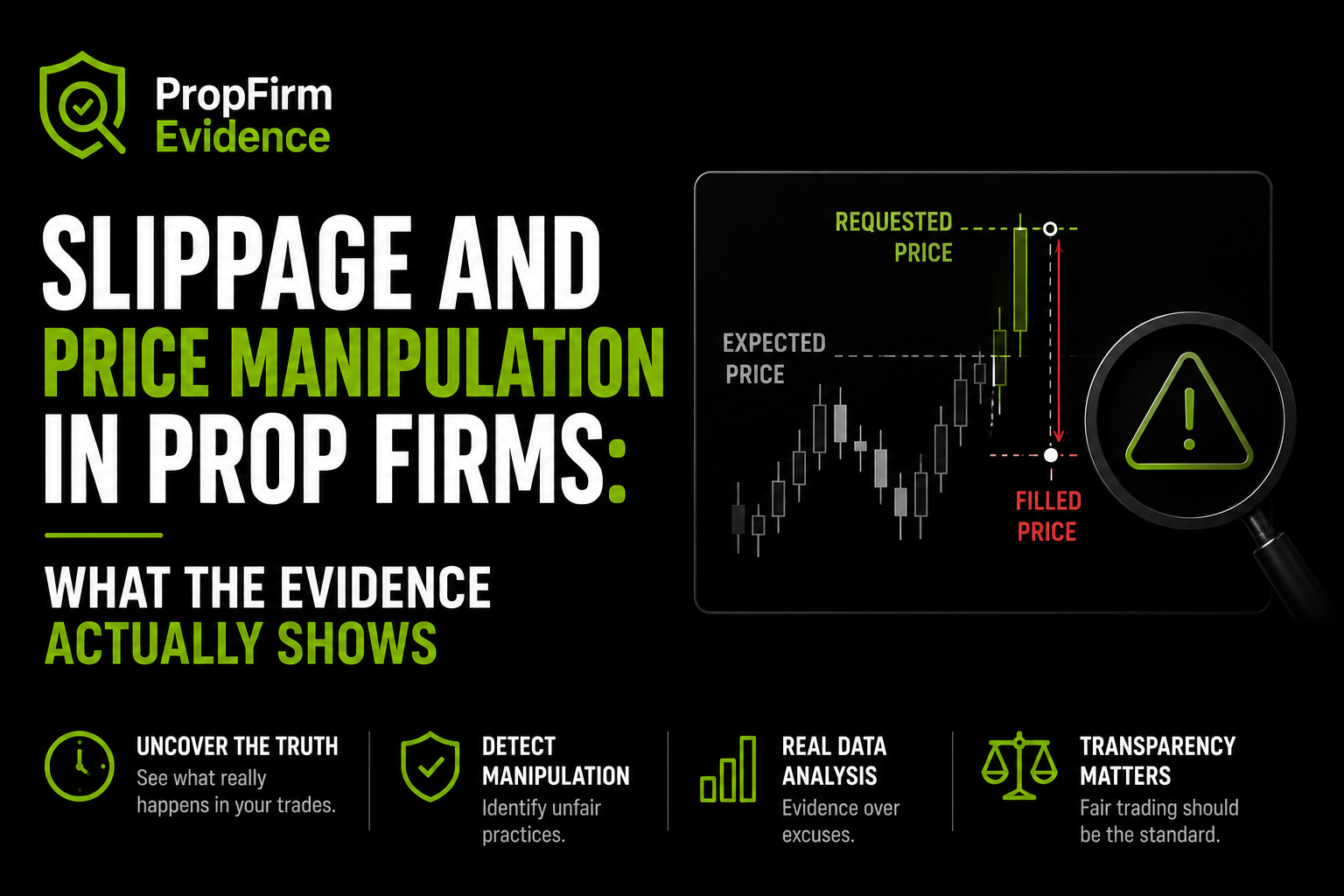
Slippage is one of the most debated topics in the prop firm industry.
A trader places an order, expects one price, and gets another. A stop-loss is hit even though another chart looks different. A position closes during a fast move, and the result feels unfair.
It is easy to jump straight to manipulation.
Sometimes the concern is worth investigating.
But not every poor fill, widened spread, or unexpected loss is proof that a firm is trying to manipulate prices. Markets move quickly. Liquidity changes. Platforms differ. Execution is rarely as simple as the candle on the screen.
This article explains how slippage works, how a prop firm may process a trade, what evidence actually matters, and how traders can judge whether a provider is trustworthy, transparent, and fair.
What Slippage Means in a Prop Firm Trade
Slippage is the difference between the price you expected and the price where your order was actually executed.
You might click buy at 2,350.00 and receive a fill at 2,350.20. You might place a stop-loss at 2,345.00 and be closed at 2,344.70. That difference is slippage.
It can happen on entries, exits, stop-loss orders, market orders, pending orders, and during fast market movements.
Slippage is not automatically suspicious.
It happens in forex, futures, commodities, indices, crypto, and CFDs. It can happen with a broker, a prop firm, or an institutional desk. The market does not freeze when you click a button. Prices can change between the moment an order is sent and the moment it is executed.
That matters because a small execution difference can change the result of a trade.
On one position, the effect may be minor.
Across hundreds of positions, poor execution can affect profit, drawdown, risk management, and confidence.
Why Slippage Happens Before You Blame Manipulation
The first mistake many traders make is treating all slippage as manipulation.
That is too simple.
Execution depends on several moving parts. When those parts change, the final price can change too.
Liquidity and available prices
Liquidity is the amount of buying and selling interest available at different prices.
When liquidity is deep, orders are usually easier to execute close to the expected level. When liquidity is thin, the next available price may be worse.
This is common around:
- Major economic releases
- Market open and close
- Sudden geopolitical headlines
- Low-volume sessions
- Fast reversals
- Large order flow
If a trader uses a large position size during thin conditions, the order may not be fully available at the first visible price. The platform then has to execute at the next available level.
That can create a worse fill.
It can also create a better fill in some cases.
Volatile market conditions
During volatile conditions, prices can move several ticks in a fraction of a second.
This is especially common during news events, such as inflation data, central bank decisions, employment reports, and earnings releases on related instruments.
A chart may show one candle.
The actual order book can change many times inside that candle.
That is why a stop-loss can be filled beyond the level shown on the chart. The chart is a visual summary. Execution happens inside the live pricing environment.
Spread changes
The spread is the difference between the bid and ask price.
Many traders only look at one side of the chart. That creates confusion.
A buy order normally interacts with the ask. A sell order normally interacts with the bid. A stop may be triggered by one side of the market even when the visible chart appears not to have reached the level.
During fast markets, the spread can widen quickly.
That does not automatically mean manipulation. It may simply mean liquidity providers are quoting wider prices because risk has increased.
However, repeated and extreme spread behaviour on one platform may deserve investigation.
How a Prop Firm Platform Handles Execution
A prop firm does not always operate like a traditional live broker account.
This is one of the main reasons traders misunderstand execution.
Some proprietary trading firms use simulated environments, especially during challenges or evaluations. Others use live brokerage infrastructure, hybrid routing, internal risk systems, or outsourced technology. Some may copy profitable traders to live capital only after certain conditions are met.
The exact business model matters.
Simulated accounts are not always fake pricing
A simulated account can still use real-time market data.
The word simulated does not automatically mean prices are invented. It usually means the account is not directly sending every order into the live market.
That said, simulated execution can still behave differently from live execution.
Reasons include:
- Different server rules
- Internal risk parameters
- Different data feeds
- Platform latency
- Spread modelling
- Order processing logic
- Execution settings
These differences can affect the final fill.
A trader should not assume all simulated execution is unfair. But they should understand that a simulated environment may not match a live account perfectly.
Why different providers show different prices
Two platforms can show different highs, lows, spreads, and timestamps.
That can happen because they use different liquidity providers, different aggregation methods, different server locations, or different quote filters.
This is normal within reason.
A small difference between one broker and another does not prove a scheme.
A large, repeated, one-sided difference is more serious.
The question is not, “Can I find a different price somewhere else?”
The better question is, “Is the difference systematic, material, and unsupported by comparable market data?”
Can a Prop Firm Manipulate Prices?
A prop firm could technically design unfair conditions if its systems, controls, and incentives allow it.
That does not mean every complaint proves manipulation.
This topic needs careful language.
Manipulation means more than bad execution. It suggests intentional behaviour designed to distort market conditions, trigger losses, deny profit, or create an unfair result for the trader.
That is a serious claim.
To support it, you need evidence that goes beyond one screenshot.
What weak evidence looks like
Weak evidence usually includes:
- One trade shown in isolation
- A screenshot without bid and ask data
- No exact timestamp
- No order ID
- No comparison with multiple independent feeds
- No record of spread at the time
- No platform logs
- No context around news events
- No sample size
This kind of evidence may show frustration.
It does not prove manipulation.
A single bad experience can still be real. The trader may genuinely have received poor execution. But an isolated complaint does not show whether the event was normal, technical, accidental, or manipulative.
What stronger evidence looks like
Stronger evidence is repeatable and measurable.
It may include:
- A large sample of trades
- Time-stamped order records
- Tick data
- Bid and ask comparison
- Spread history
- Platform logs
- Multiple independent price feeds
- Comparable execution from other providers
- Evidence of one-sided outcomes
- Repeated anomalies during similar conditions
The strongest case would show that execution is consistently asymmetric.
For example, negative slippage appears often, positive slippage almost never appears, and the pattern cannot be explained by volatility, liquidity, spread, order type, or timing.
That kind of evidence deserves attention.
Slippage, Profit and Drawdown Rules
Slippage matters more in prop trading because accounts are usually governed by strict rules.
A small execution difference can affect whether a trader passes a challenge, keeps a funded account, or breaches a drawdown rule.
This is where frustration builds.
A trade that would have survived on one feed may fail on another. A stop hit by a spread spike may push the account below the daily limit. A delayed exit may reduce unrealized profits before the trader can close.
From the trader’s perspective, this can feel arbitrary.
From the provider’s perspective, it may be explained by the stated execution conditions and terms of service.
Both views matter.
The real issue is whether the rules and execution model are clear before the account is purchased.
Daily drawdown and trailing drawdown
Drawdown rules can make slippage feel much more serious.
If a firm uses trailing drawdown, the account limit may move as equity rises. If unrealized profits are included, a winning position that retraces can reduce the safety margin quickly.
A small adverse fill can then create a rule breach.
This is why traders must understand the exact risk parameters before starting.
You need to know:
- Whether drawdown is based on balance or equity
- Whether open profit affects the limit
- Whether the limit trails
- Whether spreads can trigger stops
- Whether positions may be held during news
- Whether weekend holding is allowed
- How violations are calculated
A clear firm explains this plainly.
A weak one hides behind vague wording.
Regulatory Oversight and the Prop Firm Industry
The prop firm industry has grown quickly, but it does not always sit inside the same regulatory structure as traditional brokerage services.
That creates confusion for traders.
Some firms do not offer brokerage accounts directly. Some operate as evaluation companies. Some provide simulated trading environments. Some work with a broker or technology provider. Some serve clients globally while being based in jurisdictions with different standards.
This does not automatically mean they are unsafe.
But it does mean traders should be careful.
Why regulatory status matters
Regulatory oversight can influence how a company handles complaints, client funds, advertising claims, operational controls, and business conduct.
If a company is unregulated, traders may have fewer formal routes when something goes wrong.
That matters when there is a dispute about execution, payout, withdrawal, or rule interpretation.
A regulator such as the SEC may not oversee every prop-style evaluation product, especially when the company is not offering securities trading in the usual sense. Different countries also treat these models differently.
So the trader should not assume protection exists.
They should check.
Compliance and transparency
Compliance is not only about legal registration.
It is also about behaviour.
A transparent provider should explain:
- Who operates the business
- Where the company is based
- What instruments are offered
- Whether accounts are simulated or live
- Which platform is used
- How orders are executed
- What restrictions apply
- How payouts are reviewed
- What data is available after disputes
- What happens during abnormal market conditions
This kind of transparency builds trust.
It does not remove all risk, but it gives traders a clearer basis for decision-making.
Common Misconceptions About Prop Firm Slippage
Many disputes come from misunderstanding rather than misconduct.
That does not mean traders should accept every explanation. It means they should know what they are looking at.
“My chart did not touch my stop, so it was unfair”
This is one of the most common complaints.
The problem is that the visible chart may not show the trigger side of the market.
A long position may be stopped based on the bid. A short position may be stopped based on the ask. If the chart only displays one side, the trader may think the level was never reached.
Spread widening can also cause this.
This is why bid and ask data matters.
Without it, the screenshot is incomplete.
“Another platform showed a different price”
That may be true.
But different pricing does not automatically prove wrongdoing.
A platform may use different liquidity providers, quote aggregation, server time, or symbol specifications.
The key issue is scale and consistency.
One different candle is not enough.
Repeated abnormal differences across similar instruments and time periods are more meaningful.
“The firm only slipped my losing trades”
This claim needs data.
Human memory is biased. Traders often remember bad fills more clearly than good ones.
To test the claim, record every entry and exit. Track positive and negative slippage separately. Compare market conditions. Review order type, time of day, and spread.
If the data shows that adverse execution happens systematically while favourable execution is absent, then the concern becomes stronger.
Without data, it remains a suspicion.
How to Assess Whether a Firm Is Trustworthy
A trustworthy firm does not need to be perfect.
No provider can remove all slippage, all platform issues, or all market disruption.
The better question is whether the company behaves fairly, explains its rules clearly, and responds properly when problems occur.
Read the terms of service carefully
The terms of service are not exciting, but they matter.
Look for rules on:
- News trading restrictions
- Maximum loss limits
- Daily loss calculations
- Prohibited strategies
- Payout conditions
- Account termination
- Copy trading
- Use of expert advisers
- Platform errors
- Dispute process
- Data access
Pay attention to vague language.
Words like “abusive”, “toxic”, “gambling”, or “unfair” may be valid in some contexts, but they can also become broad enough to justify almost any denial if not defined properly.
Clear rules protect both sides.
Vague rules create uncertainty.
Check how disputes are handled
Execution problems will happen at some point.
What matters is how the firm handles them.
A serious provider should ask for details, review logs, explain the result, and give a clear answer.
A weak provider may send a generic response or point to a broad rule without evidence.
Before signing up, check how the company responds to complaints. Look at whether traders receive detailed explanations or vague dismissals.
Support quality is part of execution quality.
Look beyond social media noise
Social media can be useful, but it is not enough.
Some complaints are valid. Some are incomplete. Some come from traders who broke rules and want someone to blame. Some positive reviews may be promotional or shallow.
Look for patterns.
Are many traders reporting the same problem?
Do the complaints include timestamps, order IDs, and comparison data?
Does the company respond clearly?
Are there repeated payout or withdrawal issues?
Is the same platform issue appearing across many accounts?
Patterns matter more than isolated posts.
How Traders Can Test Slippage and Fill Quality
A trader cannot control every part of execution.
But they can collect better evidence.
This turns emotion into analysis.
Build a simple execution log
Track each trade with basic details:
- Symbol
- Direction
- Order type
- Expected entry
- Actual entry
- Expected exit
- Actual exit
- Time of execution
- Spread at entry
- Spread at exit
- Market session
- News conditions
- Screenshot or export file
- Notes on platform behaviour
This does not need to be complicated.
The goal is to build a record.
After 100 or more trades, patterns become easier to see.
Compare independent feeds
Use more than one independent source when reviewing execution.
For example, a trader might compare the prop platform with a regulated broker, a futures chart where relevant, and an independent charting service.
You are not looking for perfect matching.
You are looking for reasonable alignment.
If one feed repeatedly shows extreme spikes that others do not show, that is worth documenting.
Separate normal execution from unusual behaviour
Normal execution differences include:
- Wider spreads during major news
- Small variations between providers
- Slippage during fast moves
- Different bid and ask triggers
- Session-based liquidity changes
Unusual behaviour may include:
- Repeated spikes only on one feed
- Stops triggered far beyond comparable data
- One-sided slippage over a large sample
- Platform freezes during profitable exits
- Delayed execution that systematically harms traders
- Rule breaches caused by unexplained price behaviour
The difference is evidence.
A disciplined trader investigates before accusing.
Slippage and Trading Restrictions
Many prop accounts include trading restrictions.
These restrictions can affect how slippage is judged.
For example, a firm may ban trading around high-impact news events. If a trader opens a position during that restricted window and receives poor execution, the dispute may become more difficult.
Some firms also restrict scalping, latency arbitrage, hedging, high-frequency execution, copy trading, or certain expert advisers.
The issue is not whether the trader likes the rules.
The issue is whether the rules are clear before purchase and applied consistently.
Why restrictions exist
Some restrictions exist because the business model is asymmetric.
A trader may pay a relatively small fee for access to a larger simulated account. The company then controls risk through rules, evaluation stages, payout reviews, and account limits.
That model can work when expectations are clear.
It becomes problematic when the rules are unclear, overly broad, or applied after the trader becomes profitable.
A fair firm makes the restrictions obvious.
An unfair one leaves room to exploit technicalities.
The Role of Business Model in Execution Concerns
To understand execution disputes, traders need to understand incentives.
A prop firm may earn revenue from challenge fees, subscriptions, commissions, spreads, data agreements, copy trading, or funded trader performance.
Those incentives matter.
A company that benefits mainly when traders fail may face more scepticism.
A company that can identify skilled traders and share in their gains may have a stronger reason to support good execution.
Reality is not always simple.
Some companies may use mixed models.
Evaluation accounts and funded accounts
Execution may differ between an evaluation account and a funded account.
In some cases, both are simulated. In others, funded accounts may be monitored for live allocation or copied into external liquidity.
A trader should know which model applies.
Questions to ask include:
- Is the account simulated?
- Are successful traders copied to live capital?
- Who is the counterparty to the trade?
- Does the company profit from trader losses?
- Are spreads marked up?
- Are commissions disclosed?
- Are execution reports available?
- Which platform is used?
A serious provider should not be defensive about these questions.
How Manipulative Conditions Could Appear
It is useful to understand what manipulative conditions might look like, without assuming they are present everywhere.
A manipulative setup might involve prices being moved artificially to trigger stops, execution being delayed only when traders are in profit, spreads widening beyond normal market behaviour, or payouts being denied using unclear rules after the account performs well.
It might also involve a company using vague restrictions to remove accounts after profitable trading, while advertising easy access and quick payouts.
These are serious concerns.
But again, the standard is evidence.
A claim that a firm can manipulate a feed is not the same as proof that it did.
Signs that deserve caution
Be cautious when you see:
- No clear company information
- No meaningful execution disclosure
- Very broad rule language
- Sudden changes to payout conditions
- Poor dispute handling
- No data provided after complaints
- Unrealistic marketing claims
- Repeated complaints about the same issue
- Unexplained platform outages
- Refusal to explain price anomalies
- Large differences from independent data during normal conditions
None of these signs alone proves misconduct.
Together, they may indicate higher risk.
What To Do If You Suspect Price Manipulation
Do not start with anger.
Start with evidence.
If you contact support with only an emotional accusation, you make it easy for the complaint to be dismissed. If you provide clear data, the issue becomes harder to ignore.
Collect the right information
Before contacting the provider, gather:
- Account number
- Trade ID
- Symbol
- Order type
- Entry and exit times
- Expected price
- Actual price
- Stop-loss or take-profit level
- Spread at the time
- Screenshots showing bid and ask where possible
- Platform logs
- Comparable independent price data
- Details of any news events
Keep the message factual.
Avoid exaggeration.
The goal is to get a review, not to win an argument.
Ask clear questions
A useful support request might ask:
- What price feed was used at the time?
- What was the bid and ask when the order triggered?
- Was there a spread expansion?
- Was the execution affected by market volatility?
- Can the firm provide an execution log?
- Was the order affected by platform latency?
- Which rule explains the result?
These questions are specific.
They also make the provider’s answer easier to judge.
Prop Firm Profit, Loss and Trader Psychology
Execution issues become harder to handle when emotion is already high.
A trader who has just taken a loss may interpret every platform difference as hostile. A trader close to a payout may feel any adverse event is intentional. A trader in a drawdown may become more sensitive to every tick.
That is understandable.
But it can also distort judgement.
Good trade management includes emotional control as well as technical control.
When something goes wrong, pause before reacting.
Review the data.
Check the spread.
Check the timestamp.
Check independent feeds.
Check the rules.
Then decide whether the issue is normal, questionable, or serious.
This approach protects you from two mistakes.
The first is trusting a poor provider for too long.
The second is blaming the provider every time the market behaves badly.
How to Choose a Prop Firm With Better Transparency
There is no perfect way to remove risk from prop trading.
But there are practical ways to reduce it.
Start by looking for clarity.
A good firm should make its rules easy to find, easy to understand, and consistent with its marketing.
Practical checks before signing up
Before paying for a challenge, review:
- Company background
- Platform provider
- Account type
- Execution model
- Spread and commission information
- Drawdown calculation
- Payout rules
- News restrictions
- Prohibited strategies
- Support reputation
- Complaint patterns
- Rule change history
Do not rely on discount codes or influencer recommendations.
A cheap challenge can become expensive if the conditions are poor.
Look for realistic claims
Be careful with any company that makes trading look easy.
Prop trading is difficult. Most traders fail challenges. Losses are normal. Execution costs exist. Rules matter.
A trustworthy firm does not need to promise easy earnings.
It should explain the risk clearly.
If the marketing sounds too smooth, read the rules twice.
The Balanced View on Prop Firm Slippage and Manipulation
There are two extreme views, and both are usually wrong.
One view says every prop firm is manipulating traders.
The other says every complaint is just a bad trader making excuses.
The truth is more balanced.
Slippage is normal.
Execution differences are normal.
Spreads widen.
Liquidity disappears.
Platforms vary.
Traders misunderstand bid and ask pricing.
At the same time, poor transparency, weak oversight, vague rules, and unfair business practices can create real problems.
A trader should not be naïve.
But they should also not treat every losing trade as proof of fraud.
The best approach is calm, structured, and evidence-based.
Final Thoughts on Prop Firm Slippage, Fill Quality and Oversight
Slippage is not the enemy.
Ignorance is.
A trader who understands execution is less likely to panic after a bad fill, less likely to make false accusations, and more likely to recognise a genuine problem when it appears.
Before judging a prop firm, look at the evidence.
Check the execution data.
Compare independent feeds.
Review the terms.
Understand the platform.
Study the rules around drawdown, withdrawal, profit, and restrictions.
Ask whether the issue is isolated or systematic.
A fair market environment does not mean perfect execution on every trade. It means clear rules, reasonable pricing, consistent treatment, proper oversight, and honest communication when something goes wrong.
That is what traders should expect.
And that is what every serious firm should be willing to provide.