Prop Firm Payouts: Why Traders Are Not Getting Paid
A prop firm can look good before you join.
The offer may include a large account, a generous profit split, simple rules, fast payouts and a low challenge fee.
But none of that matters if the trader cannot withdraw profit after doing everything correctly.
That is why prop firm payout reliability is one of the most important things to check before you buy a challenge. A trader needs to know how the process works, what can delay payment, what can lead to rejection, and how to verify whether firms actually have a history of paying successful traders.
This guide explains how payouts work, what traders get wrong, how to avoid common mistakes, and what to check before trying to get funded.
How Prop Firm Payouts Actually Work
Prop firm payouts work through a review and approval process.
The trader first needs to meet the company’s rules. This usually means completing a prop firm challenge, reaching the funded stage, trading within the allowed limits, and waiting until the correct payout window.
Once those conditions are met, the trader submits a payout request.
The company then checks the account before approving money.
That check usually includes:
- Whether the trader respected drawdown limits
- Whether any breach occurred
- Whether the trading rules were followed
- Whether the account reached the correct payout cycle
- Whether KYC has been completed
- Whether the withdrawal details are correct
- Whether the profit is eligible under the terms
This is the part many traders misunderstand.
Seeing profit on a dashboard does not always mean it is ready to withdraw. The company still has to review and approve the request.
That review should be clear, consistent and based on written rules.
The Basic Payout Structure
The payout structure explains how and when the trader is paid.
Most companies use a profit split. This means the trader keeps a percentage of approved profit and the company keeps the rest.
For example, if the profit split is 80 percent and the trader makes £2,000 of approved profit, the trader receives £1,600 before any payment provider fees, currency conversion or other charges.
Some companies offer a higher split after several successful withdrawals. Others keep the same terms from the start.
A proper payout structure should explain:
- When the first payout becomes available
- How often future withdrawals can be requested
- Whether minimum trading days apply
- Which payment methods are supported
- Whether there is a minimum withdrawal amount
- Whether the trader must close open positions first
- What happens if a rule is broken
If these details are hard to find, that is not a small issue.
A serious trader should understand the payment rules before placing the first trade.
Why Payout Reliability Matters More Than the Challenge Fee
Many traders focus too much on the upfront price.
A cheap challenge fee can look attractive, but it does not mean much if the company has poor communication, vague rules or weak payout systems.
The better question is simple.
Can the company pay traders consistently when they meet the conditions?
Reliable companies usually have clear terms, stable rules, visible payout track records and professional support. They explain what is allowed, what is not allowed, and what can block a withdrawal.
Unreliable companies often do the opposite.
They promote big accounts and high splits, but leave important details buried in the fine print.
That creates problems later.
The Typical Withdrawal Process
The withdrawal process usually starts once the trader reaches an eligible payment date.
Some companies allow requests every 14 days. Others work on a monthly schedule. Some allow the first payout only after a certain number of calendar days or after at least one required trading day.
The usual process looks like this:
- The trader reaches the eligible date.
- The account is checked for compliance.
- The trader submits payment details.
- Verification is completed if required.
- The company reviews the account history.
- The request is approved or rejected.
- Funds are sent through the selected method.
The first payout often takes longer than later ones.
That is normal because the first request may involve extra identity checks, manual review and payment setup.
The important issue is not whether a payment takes a little longer than expected.
The important issue is whether the company follows its stated processing time and communicates clearly.
Verification and KYC
Verification is a normal part of most funded account models.
A company may ask for identity documents, proof of address, payment method confirmation or other KYC checks before releasing money.
This is not automatically a red flag.
KYC helps reduce fraud, confirm identity and make sure the right person receives the funds.
Problems usually appear when the process is vague or keeps changing.
For example, a trader should be cautious if the company repeatedly asks for the same documents without explaining the problem, delays the review beyond its own published timeframe, or refuses to confirm what is still required.
Good preparation helps.
Use your real details from the start. Make sure the name on your account matches your payment method. Do not use another person’s bank account or wallet. Upload clear documents. Check requirements before the payment date arrives.
Simple mistakes can slow down the process.
Why Payouts Get Delayed
Payouts get delayed for several reasons.
Some delays are administrative. Others are related to account review or rule checks. A delay does not always mean the company is trying to avoid payment.
The key is the reason.
A professional company should explain what is happening and give a realistic update.
Account Review
Most companies review the account before approving money.
They may check trade history, position sizing, loss limits, restricted strategies and execution patterns.
This review protects the company from abuse and helps confirm that the trader earned the profit within the rules.
That is reasonable.
But the review should not be endless or unclear.
If the company says the account is “under review”, the trader should be able to ask what that means, how long it normally takes, and whether any specific issue has been found.
Payment Provider Delays
Sometimes the request is approved, but the payment provider slows the transfer.
Bank payments can take several business days, especially across countries. Some providers also carry out their own checks before releasing funds.
Crypto can be faster, but it is not instant in every case. Network congestion, wallet checks, internal approval queues and batching can all affect timing.
This is why payout speed depends on more than the company alone.
It also depends on the payment method.
High Request Volume
A company can also experience delays when many traders request withdrawals at the same time.
This often happens after promotions, large discount campaigns or popular payment dates.
A short delay during a busy period is not always serious.
Poor communication is more concerning.
If support gives no useful update after the stated processing period, the trader should record the issue and ask for a clear explanation.
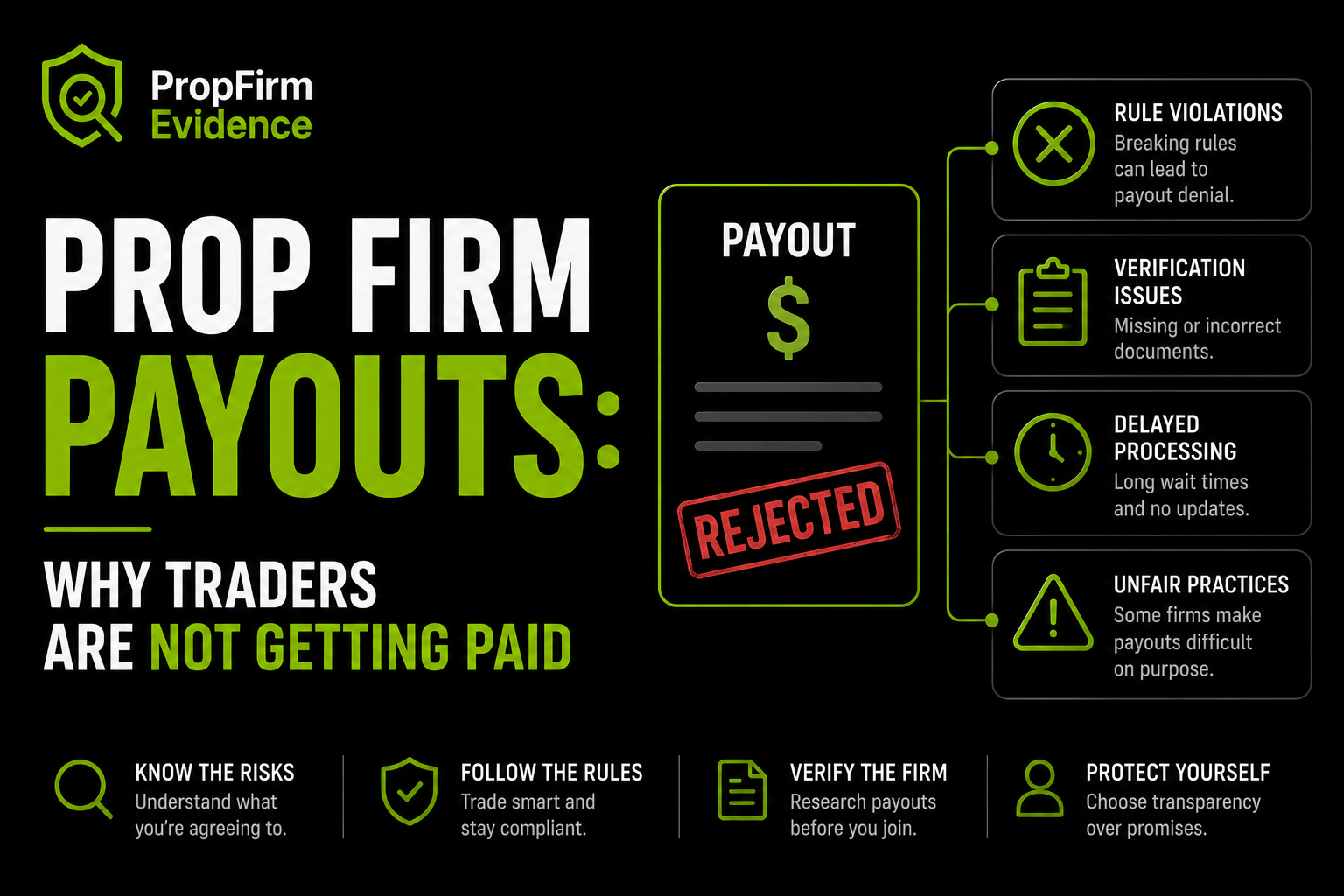
Why Payout Requests Are Rejected
A rejected request is different from a delayed one.
A delay means the payment is still being processed. A rejection means the company has decided not to approve it in its current form.
Sometimes the problem can be fixed. Sometimes the account is closed.
It depends on the reason.
Breach of Trading Rules
A breach is one of the most common reasons for rejection.
This may include exceeding daily loss limits, breaking maximum drawdown, using banned strategies, account sharing, trade copying, or trading during restricted news events.
Every company has different rules.
Some allow news trading. Some restrict it. Some allow weekend holding. Others do not. Some allow crypto positions, but with different conditions. Some require minimum trading days before money can be requested.
Do not assume one company works like another.
Read the rules before starting.
Rule Violations and Clear Evidence
Rule violations should be explained clearly.
If a company rejects a request, it should identify the exact rule, the relevant trade or behaviour, the date of the issue and the evidence used.
A vague message is not enough.
A trader should not simply accept “risk team decision” without details when money is being refused.
That does not mean every rejection is unfair.
It means the company should be able to justify the decision using its published rules.
Incorrect Documents or Payment Details
Some requests are rejected because the information is incomplete or wrong.
Common problems include:
- Unclear ID documents
- Mismatched names
- Wrong bank details
- Invalid wallet address
- Missing proof of address
- Payment account not matching the verified person
These issues can often be fixed.
A rejected request does not always mean permanent refusal. It may mean the trader needs to correct the documents and submit again.
How to Verify Payout Track Records
Before buying a challenge, check the payout track carefully.
No single piece of evidence is perfect. Screenshots can be edited. Reviews can be biased. Complaints can miss context. Affiliate content can be promotional.
You are looking for patterns.
A useful payout track shows repeated withdrawals from different traders over time.
One large screenshot is not enough.
Consistent payout track records are stronger because they show that the company has paid different people across different periods and conditions.
Look for:
- Recent payment proof
- Non-affiliate trader feedback
- Clear support responses
- Public rules that match trader experience
- Stable terms over time
- Transparent dispute handling
- Verified payout data where available
The goal is not to find a perfect company.
The goal is to avoid obvious risk.
Do Prop Firms Actually Pay?
Yes, many prop firms actually pay traders who follow the rules, complete checks and request money correctly.
But not every company is equally reliable.
Some have stronger systems, longer histories and clearer operations. Others grow quickly, change rules often, or rely heavily on marketing.
A trader should judge each company separately.
How Proprietary Trading Firms Operate
Proprietary trading firms operate in different ways.
Traditional firms may hire traders and allocate company capital directly. Online evaluation companies usually use challenge models, simulated accounts, funded-style accounts and performance-based rewards.
The online model can work.
But the company still needs proper systems.
It must handle support, account review, compliance, payment processing and trader disputes. If the operation is weak, problems can appear when more traders start requesting money.
A company that offers huge accounts, very low fees, instant funding and unusually generous terms may still be legitimate.
But the trader should look for stronger evidence before paying.
Why Traders Get Different Results
Two traders can use the same company and have very different experiences.
One trader may receive money quickly.
Another may wait several days.
Another may face rejection.
That does not automatically prove the company is good or bad.
Context matters.
Were both traders verified? Did they use the same payment method? Did one break drawdown? Did one use a restricted strategy? Did one request money during a holiday? Did the company update its rules between requests?
Single stories can be misleading.
Patterns are more useful.
Payout Speed by Payment Method
Payout speed depends partly on the method used.
Some companies offer bank transfer, payment platforms, stablecoin payments or other systems. Each one has advantages and drawbacks.
Crypto Withdrawals
Crypto withdrawals are popular because they can be quick and accessible across borders.
But they also carry specific risks.
The wallet address must be correct. Network fees can change. Transfers may require confirmations. The company may also batch payments instead of sending each one immediately.
A trader should double-check every wallet detail before submitting a request.
A wrong address may not be recoverable.
Bank and Platform Payments
Bank withdrawals may take longer.
International transfers can be delayed by banking checks, holidays or compliance processes.
Third-party platforms can make payments easier, but they may also require their own review.
Before choosing a company, check which payment methods are available in your country.
Do not assume the advertised method works for everyone.
Prop Trading, Brokers and Market Conditions
Prop trading rules are not only about profit and loss.
The broker environment, spreads, commissions, execution and permitted markets can all affect performance.
A strategy that works with one broker setup may not work the same way elsewhere.
This matters for forex, indices, commodities and crypto.
Before you trade, check:
- Which markets are allowed
- Whether spreads are fixed or variable
- Whether commissions apply
- Whether news trading is restricted
- Whether holding overnight is allowed
- Whether weekend exposure is allowed
- Whether stop-loss rules apply
A trader who ignores these details can pass the challenge and still run into problems later.
FTMO and Established Companies
FTMO is often mentioned because it is one of the better-known names in the funded trader space.
That does not mean it is the only option.
It also does not mean every newer company is unreliable.
It simply shows why history matters.
An established company is easier to assess because there is more public feedback, more payment evidence, and more discussion around support and disputes.
New companies can still be legitimate firms.
But because there is less history, the trader needs to be more cautious.
Instant Funding and Payout Reliability
Instant funding can sound attractive.
The trader does not need to pass the challenge in the usual way and may get access more quickly.
But instant does not mean easy.
These programmes often have stricter drawdown rules, higher costs, lower split terms or tighter payment conditions.
Before buying, check whether the model suits your trading style.
Ask:
- Are the rules realistic?
- Is the drawdown too tight?
- Is the fee fair?
- When can money be requested?
- Are traders being paid consistently?
- Has the company shown reliable payment behaviour?
Speed should never replace proper checks.
Prop Firm Payout Checklist
Use this checklist before joining any company.
It will not remove every risk, but it can help you avoid obvious mistakes.
Check:
- First payout rules
- Payment schedule
- Minimum trading days
- Maximum drawdown
- Daily loss rules
- Profit split
- KYC requirements
- Payment methods
- Processing time
- Supported countries
- Restricted strategies
- News trading rules
- Weekend holding rules
- Recent trader complaints
- Public payment proof
- Support quality
- Whether rules have changed recently
Every prop firm should make these details easy to find.
If the terms are unclear before you join, they may become even more frustrating later.
How to Reduce the Risk of Payment Problems
A trader cannot control everything a company does.
But you can reduce avoidable risk.
The approach is simple.
Choose carefully. Read the terms. Manage risk. Keep records. Complete checks early. Do not rely only on sales pages or discount codes.
Read the Fine Print Before You Trade
The fine print matters.
Many traders know the headline numbers but miss the conditions that affect getting paid.
They know the account size, but not the trailing drawdown rule.
They know the split, but not the payment window.
They know the challenge target, but not the restricted strategy list.
Do not skim this information.
Read it before starting, then read it again before submitting a request.
Use Proper Risk Management
Risk management protects both the account and the withdrawal.
A trader who risks too much can lose eligibility quickly. Even after reaching profit, aggressive trading can cause unnecessary problems before approval.
Know your maximum loss. Know your position size. Know when you will stop for the day.
Do not gamble near a payment date.
If the goal is to withdraw, protect the account first.
Keep Clear Records
Keep a record of all important information.
Save:
- Account statements
- Trade history
- Balance screenshots
- Payment request dates
- Support conversations
- Verification status
- Payment references
- Rule pages at the time you joined
This helps if there is a dispute.
A trader with clear records can communicate with support more effectively.
When a Delay Becomes a Warning Sign
Not every delay is a red flag.
A pattern of poor communication is different.
Be careful if the company:
- Exceeds its stated timeframe without explanation
- Gives vague answers
- Keeps changing the reason for delay
- Refuses to identify an alleged breach
- Deletes public complaints
- Changes payment rules suddenly
- Shows repeated complaints from different traders
- Only displays payment proof from affiliates
One complaint does not prove a company is unsafe.
Repeated patterns are more important.
What to Do if a Payout Is Delayed
Start calmly.
Check the published processing period. Confirm that your documents are complete. Review the rules. Make sure payment details are correct.
Then contact support.
Keep the message short and factual.
Include your account number, request date, payment method, verification status and any reference number.
Ask for a clear update.
Do not send angry messages.
Professional communication usually gets better results.
If the delay continues, keep records of every reply.
Frequently Asked Questions
Do prop firms actually pay?
Yes, many prop firms actually pay traders who follow the rules and complete the required checks.
The important question is whether the specific company has reliable systems, clear terms and a good public record.
How long does a payment usually take?
It depends on the company, method and review process.
Some requests are completed quickly. Others take several business days. First withdrawals often take longer because extra checks are required.
Why are withdrawals rejected?
Withdrawals may be rejected because of drawdown breach, rule violations, incomplete KYC, incorrect payment details, suspicious activity or requesting outside the allowed window.
A fair company should explain the reason clearly.
Can a company deny payouts unfairly?
It can happen.
That is why records matter. If a company refuses payment, ask for the exact rule, trade evidence and review process.
Stay factual.
Are crypto payments faster?
They can be faster, but they are not guaranteed to be instant.
Internal review, wallet checks, network congestion and batching can all affect timing.
Should I choose the fastest-paying company?
Not only for speed.
Fast payment is useful, but reliability matters more. Clear rules, consistent systems and fair reviews are more important than speed alone.
Final Thoughts on Payout Reliability
A prop firm payout is the real test of the company.
Marketing can promise large accounts, high split terms and quick withdrawals. But the only thing that matters is whether traders are paid fairly when they follow the rules.
Prop firm payouts actually work when the company has clear systems and the trader understands the conditions.
Problems usually happen when rules are unclear, checks are incomplete, documents are wrong, or the trader breaks a condition without realising it.
Before joining, check the evidence.
Before placing a position, read the rules.
Before requesting money, review the account and keep records.
That is how traders reduce avoidable problems and choose companies with better payout reliability.