
The trader you can’t see: how your own brain works against your account
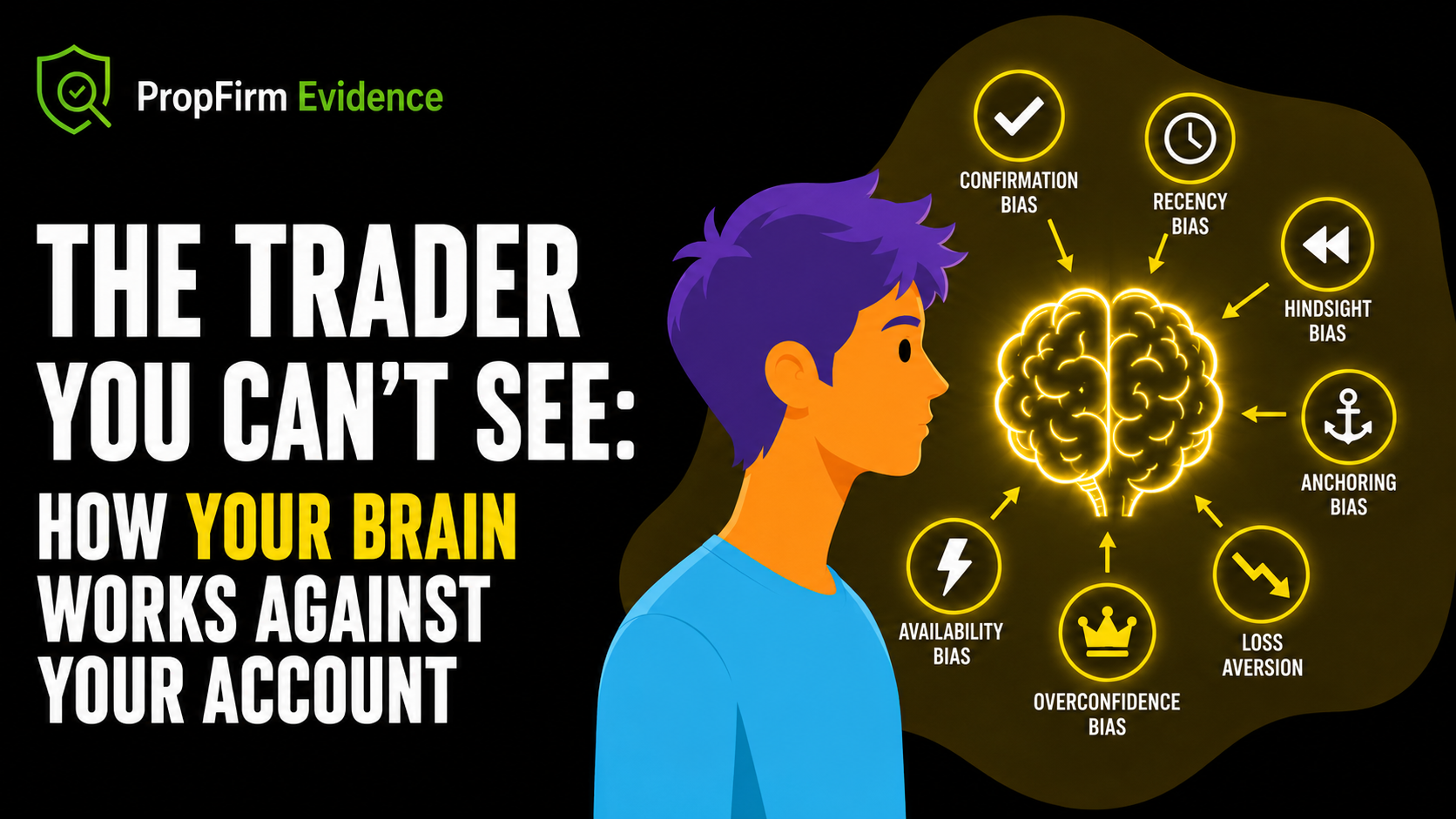
Most traders naturally focus on what is happening outside themselves: market volatility, spreads, economic news, technical levels and unexpected price movement.
But another source of error sits much closer to the decision itself: the mental shortcuts people use when interpreting information.
These shortcuts are commonly described as cognitive biases.
They are not unique to traders and they are not necessarily evidence of poor intelligence or inexperience. They are recurring tendencies in human judgement that can influence how information is noticed, interpreted and acted upon.
In trading, where decisions are often made under uncertainty, time pressure and financial risk, those tendencies can become especially relevant.
Why Biases Are Difficult to See From the Inside
A cognitive bias is a systematic tendency in judgement that can lead people away from a fully objective assessment of the available information.
Human decision-making does not involve calculating every possible variable from first principles every time a choice has to be made.
People rely on shortcuts, prior beliefs, recent experiences and simplified interpretations to make decisions efficiently.
Those shortcuts can be useful in everyday life.
The problem begins when a shortcut influences a financial decision without the trader recognising that the interpretation itself may be distorted.
A bias rarely announces itself as:
“I am currently making an irrational decision.”
It usually feels like a reasonable conclusion.
That is why awareness helps, but awareness alone is rarely enough. A stronger defence is to build decision rules that make it harder for a temporary interpretation to override the trading process.
Seven Biases Worth Knowing by Name
1. Confirmation Bias
Confirmation bias describes the tendency to give greater attention or weight to information that supports an existing belief while discounting evidence that challenges it.
In trading, this may appear after a position has already been opened.
A trader who is long may continue searching for bullish explanations while paying less attention to information suggesting that the original setup has weakened.
The risk is that analysis stops being an attempt to understand the market and becomes an attempt to defend the existing position.
A useful countermeasure is to ask:
“What is the strongest evidence that my current idea is wrong?”
That does not mean automatically reversing the trade.
It means deliberately considering evidence that does not support the position before adding risk or changing the original plan.
2. Recency Bias
Recency bias involves placing disproportionate importance on information or outcomes that happened recently.
A trader may experience several losses and conclude:
“The strategy has stopped working.”
Another may experience several wins and conclude:
“I’ve finally mastered this market.”
Both conclusions may be based on too little information.
Recent data can matter, particularly if market conditions have genuinely changed, but it needs to be interpreted within a larger sample.
A practical response is to compare short-term performance against:
The historical sample
Expected drawdown
Normal losing and winning sequences
The market conditions under which the strategy was tested
The objective is not to ignore new information, but to avoid letting the last few trades automatically outweigh everything that came before them.
3. Hindsight Bias
Hindsight bias is the tendency, after an outcome is already known, to see that outcome as having been more predictable than it actually was beforehand.
In trading, this can produce statements such as:
“It was obvious that level was going to break.”
“I knew the market was going to reverse.”
But once the chart has already completed the move, information that was ambiguous beforehand can suddenly look obvious.
This can create an exaggerated sense of forecasting ability.
A trading journal is particularly useful here.
Compare what you actually wrote before entering with the explanation you are giving after the outcome is known.
If the certainty only appeared after the result, the journal can expose that difference.
4. Availability Bias
Availability bias involves giving greater weight to information that is easy to remember or immediately available.
A dramatic market crash, a recent news headline or an unusually memorable winning trade can become disproportionately influential simply because it is easy to recall.
In trading, that might mean:
Avoiding a valid setup because a similar-looking trade recently lost.
Taking a trade because a memorable previous setup worked spectacularly.
Overreacting to the first headline seen without checking whether it is actually relevant to the strategy.
A useful response is to rely more heavily on predefined information requirements.
Ask:
“What information does my strategy actually require before this decision is made?”
That helps prevent the easiest-to-recall information from automatically becoming the most important.
5. Anchoring Bias
Anchoring occurs when too much importance is placed on an initial reference point and subsequent information is interpreted around it.
In trading, the anchor might be:
An entry price
A previous support or resistance level
An analyst target
A previous high or low
A macroeconomic forecast
For example, a trader may remain convinced that a historical support level must continue to hold even after broader market structure has changed.
The better question is not:
“Was this level important before?”
It is:
“Does the current evidence still support treating this level as relevant?”
A trading plan should define which information requires the original thesis to be updated or abandoned.
6. Loss Aversion
Loss aversion refers broadly to the tendency for losses to carry greater psychological weight than comparable gains.
In trading, this can contribute to several familiar behaviours.
A trader may hold a losing position longer than planned because closing it would make the loss final.
Another may close a profitable trade early because the possibility of giving back an unrealised gain feels uncomfortable.
This can create an unhealthy pattern:
Letting losses expand while cutting winners short.
A predefined exit and risk framework can reduce the amount of discretion available when this pressure appears.
The objective is not to make losses emotionally pleasant.
It is to ensure that discomfort does not automatically rewrite the risk parameters while the trade is open.
7. Overconfidence Bias
Overconfidence appears when confidence in judgement or skill becomes greater than the available evidence justifies.
In trading, it can show up as:
Increasing position size after a winning streak
Taking more trades than the strategy requires
Reducing normal entry filters
Believing recent profits prove unusually strong forecasting ability
Taking risk outside previously established limits
Overconfidence is particularly difficult to recognise because it often appears during periods when the trader is making money.
The profitable outcome can make the behaviour look justified.
This is why risk limits should ideally remain independent from how confident the trader currently feels.
Winning Trades Can Reinforce Bad Decisions
Cognitive bias does not only matter when a trade loses.
A poor decision that produces a profitable outcome can be especially dangerous because it rewards the wrong behaviour.
For example:
A trader doubles normal position size without a valid reason.
The trade wins.
The trader concludes:
“I knew this one was different.”
The financial reward strengthens confidence in a decision process that may actually have violated the trading plan.
The next oversized trade may not produce the same outcome.
This is why process review needs to ask two different questions:
Did the trade make money?
And:
Was the decision consistent with the strategy and risk rules?
Those are not the same question.
Biases Can Interact With Each Other
Trading mistakes do not always fit neatly into one category.
Several biases can reinforce one another.
Consider a trader after five winning trades.
Recency bias may make the recent winning period feel unusually important.
Overconfidence may increase belief in personal forecasting ability.
Confirmation bias may then make bullish information easier to notice on the next trade.
Anchoring may cause the trader to stay committed to the original thesis even as conditions change.
What eventually appears as one bad trade may therefore reflect several decision errors interacting at once.
The objective is not to label every decision with a psychological term.
The value comes from recognising recurring patterns that repeatedly alter the trading process.
Awareness Alone Is Not Enough
Knowing that confirmation bias exists does not guarantee that you will recognise it while defending a losing position.
Knowing about loss aversion does not guarantee that you will calmly accept the next stop.
Knowing about overconfidence does not automatically prevent position size from increasing after a winning streak.
This is why a stronger defence is structural.
Build rules that remain in place regardless of which bias happens to be influencing the trader that day.
Build a Process That Makes Bias Harder to Act On
A Written Trading Plan
Important decisions should be defined before the trade begins wherever possible.
The plan can specify:
Valid market conditions
Entry requirements
Stop-loss placement
Profit-taking rules
Maximum position size
Conditions that invalidate the setup
The more clearly those rules are defined, the easier it becomes to identify when a later decision is being improvised.
Defined Risk Rules
Position sizing should not depend entirely on confidence.
A trader can define in advance:
Maximum risk per trade
Maximum daily exposure
Maximum number of simultaneous positions
What happens after a predefined drawdown
Whether size changes are permitted and under what conditions
This limits the ability of fear or overconfidence to change exposure without evidence.
A Trading Journal
A journal provides a record against which memory can be checked.
Useful information includes:
What did I believe before the trade?
What evidence supported the trade?
What evidence would have invalidated it?
Did my reasoning change after entry?
Did I follow the original rules?
How did I explain the result afterwards?
This is particularly useful for hindsight bias because the pre-trade record exists before the outcome can influence the story.
Use Checklists
A checklist converts abstract discipline into visible questions.
For example:
Am I adding to this position because the strategy allows it, or because I want the loss to reverse?
What evidence would prove my current view wrong?
Am I changing size because the data supports it, or because recent trades went well?
Would I take this trade if the previous trade had not happened?
These questions force a brief review before the bias becomes an action.
What Backtesting Can and Cannot Do
Backtesting can help establish whether a strategy has historically produced a repeatable result under defined conditions.
That evidence can also make it easier for a trader to distinguish normal losses from evidence that a strategy rule has actually failed.
But backtesting has limits.
It does not eliminate behavioural bias.
It does not guarantee that future market conditions will match the historical sample.
And a poorly designed backtest can itself contain bias through selective data, hindsight or overfitting.
The useful role of testing is to strengthen the evidence behind the process, not to create certainty.
Ongoing Education Helps — but It Can Also Create Noise
Learning more about markets, statistics and decision-making can improve the quality of a trading process.
But more information is not automatically better information.
A trader who continuously absorbs new opinions, indicators, social-media forecasts and market narratives may create additional opportunities for confirmation bias rather than reducing it.
Education is most useful when it helps the trader:
Define better questions
Improve testing
Recognise weaknesses in the process
Update rules when evidence genuinely supports a change
The objective is clearer decision-making, not simply more information.
A Simple Bias Review Before a Trade
Before entering or changing a position, ask:
What evidence supports this trade?
What evidence argues against it?
Am I giving too much weight to my last few trades?
Am I anchored to a particular price or forecast?
Would I make the same decision if I had no position open?
Has my position size changed because of evidence or emotion?
Does this decision still fit the written plan?
The checklist does not remove cognitive bias.
It creates a brief opportunity to catch it before it changes the trade.
What This Comes Down To
Biases are normal. They are recurring features of human judgement, not evidence that a trader is uniquely irrational.
The danger is invisibility. A biased interpretation usually feels reasonable while it is happening.
Learn the recurring patterns. Confirmation, recency, hindsight, availability, anchoring, loss aversion and overconfidence can all influence trading decisions.
Judge process separately from outcome. A profitable trade can still come from a poor decision, while a valid trade can still lose.
Use structure rather than relying only on awareness. Written rules, fixed risk parameters, checklists and journals can reduce the number of decisions left entirely to in-the-moment judgement.
Backtesting supports evidence, not certainty. It can help validate a process but does not eliminate bias or guarantee future performance.
Review your own patterns. The goal is not to diagnose every trade psychologically, but to identify behaviours that repeatedly interfere with the strategy.
Conclusion
The market is uncertain enough without adding unnoticed decision errors on top of it.
Cognitive biases cannot simply be switched off.
What traders can do is build a process that makes those biases easier to recognise and harder to act upon.
Write the rules before the pressure arrives.
Define risk before confidence changes.
Record what you believed before the outcome is known.
Review decisions separately from whether they happened to make money.
The objective is not to become perfectly rational.
It is to make fewer important trading decisions dependent on whatever interpretation happens to feel most convincing in the moment.