
When the strategy isn’t the problem: a look at “Mindful Trading”
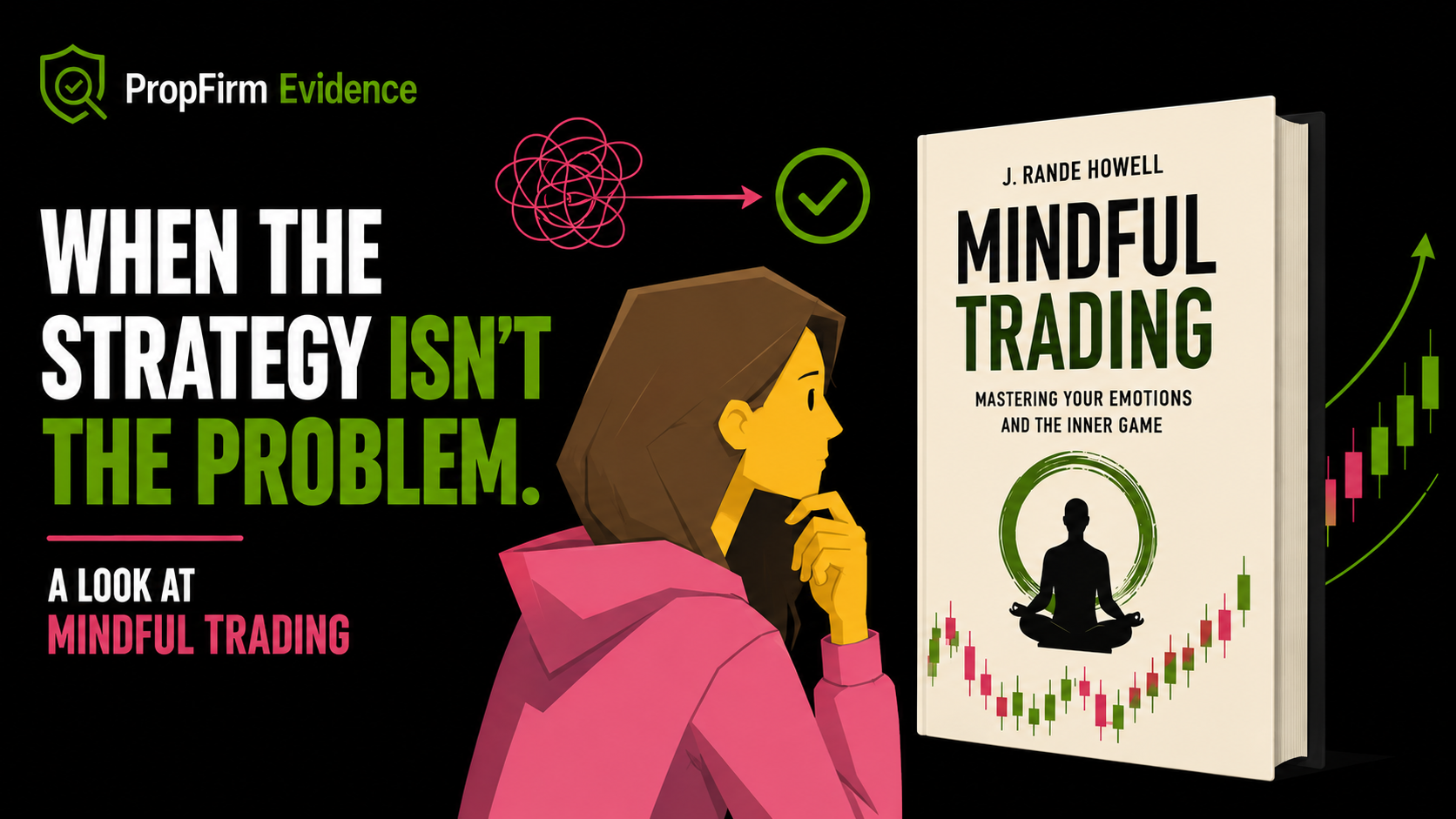
Most traders eventually run into the same wall: a plan that works on paper and in backtesting, followed by hesitation, interference or an outright freeze the moment meaningful pressure enters the decision.
Mindful Trading: Mastering Your Emotions and the Inner Game by J. Rande Howell is a book focused specifically on that gap.
It isn’t primarily a book about entries, indicators or market structure. Its focus is the internal process that can interfere with a trader’s ability to execute a plan they already understand.
Who Wrote It
J. Rande Howell approaches trading psychology from a counselling and performance-coaching perspective rather than from market analysis.
That background shapes the entire book. It reads less like a conventional trading manual and more like an examination of what happens psychologically when people repeatedly make decisions under uncertainty, financial pressure and incomplete information.
The market provides the environment. The trader’s reaction to that environment becomes the subject of the book.
The Problem the Book Is Actually Addressing
The central problem will be familiar to many traders: knowing what to do is not necessarily the same as being able to do it consistently when pressure increases.
A strategy may be clearly defined. The risk may already be calculated. The setup may meet the trader’s own rules.
And yet hesitation, fear, impulsiveness or overconfidence can still change the decision.
Howell’s approach is that these reactions should not simply be dismissed as a lack of discipline. Instead, the trader needs to understand how emotional responses to uncertainty affect perception and decision-making.
That distinction matters because telling yourself to “be more disciplined” provides very little information about what to do when the same reaction appears again.
The Core Reframe
One of the central themes in the book is the relationship between emotion and thought.
Rather than treating emotion as something that simply appears after a trader thinks negatively, Howell places considerable emphasis on the idea that an activated emotional state can shape the thoughts and interpretations that follow.
That changes the problem.
If fear is already influencing how a situation is being interpreted, attempting to overpower it with positive thinking alone may not address the underlying reaction.
The practical objective becomes learning to notice the emotional state itself, understand what is triggering it and create enough separation between the reaction and the eventual trading decision.
Uncertainty Is Part of the Experience
The book also challenges the expectation that experienced traders eventually become completely comfortable with uncertainty.
Opening a trade means accepting an outcome that cannot be known in advance.
Even when the setup is valid and the risk is controlled, the trader is still voluntarily entering a situation where loss remains possible.
The presence of discomfort therefore does not automatically mean that the strategy or decision is wrong.
The more useful question is whether that discomfort changes the way the trading plan is executed.
The Structure of the Book
The book broadly moves through two related areas.
The first examines where psychological problems enter the trading process: fear, beliefs, emotional reactions and the conflict between analytical intentions and behaviour under pressure.
Howell uses recurring trading behaviours to illustrate how similar emotional mechanisms can appear very differently from one trader to another.
The later sections become more practical, focusing on methods intended to help traders recognise and regulate their reactions rather than simply suppress them.
Developing an Observer Perspective
One of the useful ideas is learning to observe an emotional reaction without immediately identifying with it or acting on it.
Instead of:
“I am afraid, therefore this trade must be wrong.”
The trader learns to recognise:
“Fear is present. Does the trade still meet my predefined rules?”
That small separation can change how the situation is processed.
Recognising Different Internal Voices
Another distinctive idea in Howell’s framework is treating the trader’s internal experience as if several competing perspectives can appear under pressure.
There may be a fearful voice trying to avoid loss.
There may be an overconfident voice wanting to increase risk.
There may be a frustrated voice trying to recover a previous loss.
And there may be the calmer, rule-based part of the trader attempting to execute the original plan.
Identifying which perspective is currently influencing the decision can make an otherwise vague emotional problem easier to recognise.
Where the Book Earns Credit
One of the book’s strengths is that it doesn’t remain entirely theoretical.
Howell uses trader examples and recurring behavioural patterns to show how psychological problems can appear during actual decision-making.
A trader may understand the setup but repeatedly hesitate before entry.
Another may appear confident but become increasingly aggressive after success.
Another may understand risk management intellectually while abandoning it after a sequence of losses.
The value of these examples is that they make psychological concepts easier to connect with observable trading behaviour.
Where It Has Limits
This is not a trading-strategy book, and it should not be treated as one.
If the underlying problem is an untested strategy, inappropriate risk, poor execution rules or an incomplete trading plan, psychological work alone cannot establish whether the trading method has a genuine edge.
The mechanical and psychological sides of trading need to be separated.
If the strategy itself has not been properly tested, then hesitation may sometimes be rational rather than psychological.
The book becomes most relevant when a trader has already developed clear rules and repeatedly finds that emotional reactions interfere with executing those rules.
It is also a relatively dense treatment of the subject. Readers looking for a short collection of motivational trading tips may find it heavier than expected.
Who Is This Book Most Useful For?
This book is likely to be most relevant to a trader who can answer yes to questions such as:
Do I already have a defined trading strategy?
Do I understand my risk before entering?
Do I know what my trading rules require me to do?
Do I repeatedly break those rules when money, pressure or uncertainty becomes emotionally significant?
If the main problem is still finding a strategy or understanding basic market structure, there are more appropriate subjects to study first.
If the problem is execution under pressure, Howell’s work becomes considerably more relevant.
Why It’s Worth Reading
A lot of trading psychology advice ends with instructions such as “control your emotions”, “stay disciplined” or “don’t be afraid”.
The difficulty is that none of those statements explains how a trader is supposed to respond when fear, frustration or overconfidence is already present.
Mindful Trading attempts to go further by giving traders a framework for understanding the emotional process itself.
Its strongest contribution is not the idea that psychology matters — traders already hear that constantly.
It is the attempt to explain what may be happening when a trader understands the correct decision intellectually but finds themselves unable to execute it consistently under pressure.
What This Comes Down To
Psychology cannot rescue a bad strategy. The trading method, risk parameters and execution rules still need to be properly defined and tested.
Knowing and executing are different skills. Understanding what should be done does not guarantee that the same decision will be made under pressure.
Emotion is information. The objective is not necessarily to eliminate emotional reactions, but to recognise them before they take control of the trading decision.
Observe before reacting. Creating separation between an emotional response and the action that follows is one of the book’s most useful themes.
This is a specialist book. It makes the most sense for traders whose mechanical trading process is already reasonably developed but whose execution repeatedly changes once real pressure appears.
For that specific problem, Mindful Trading offers a deeper examination than the usual advice to simply “be more disciplined”.