
Why knowing the market isn’t enough: a look at “Trading in the Zone”
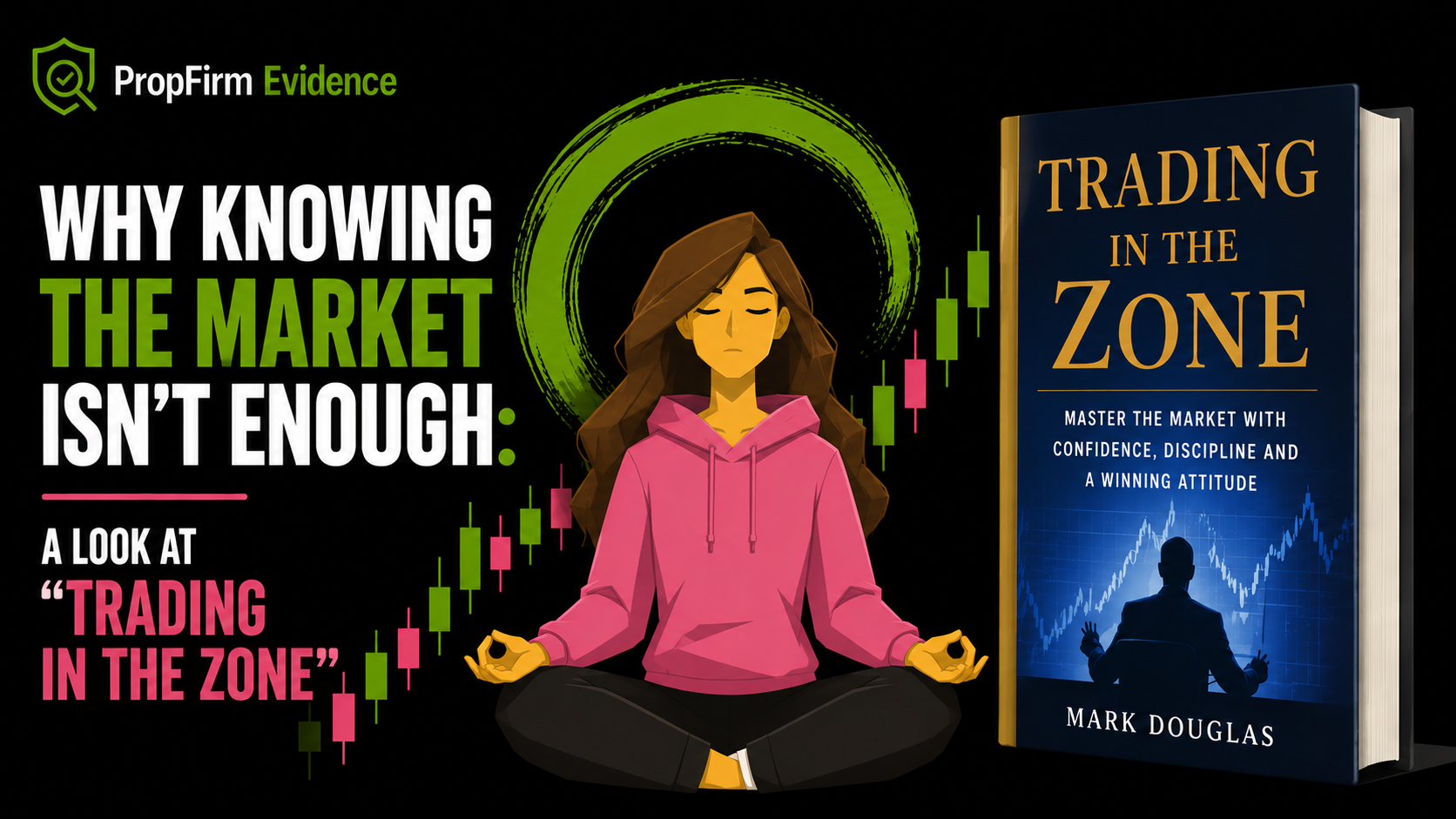
Plenty of traders reach a point where technical skill stops being the main bottleneck. The analysis appears sound, the setups are defined, and yet actual execution still fails to produce the results the strategy should theoretically deliver.
Trading in the Zone by Mark Douglas is one of the best-known books written directly about that gap.
Rather than teaching entries or market structure, the book focuses on the beliefs, expectations and emotional reactions that can interfere with a trader’s ability to execute consistently under uncertainty.
Background
Mark Douglas built much of his work around trading psychology and the mental discipline involved in financial-market decision-making.
His focus was not primarily on finding better indicators or forecasting techniques. Instead, he examined why traders who already understand their method can still behave inconsistently when fear, frustration, confidence or financial pressure enter the process.
Trading in the Zone, published in the early 2000s, became his most influential work and remains one of the most widely recognised books in the trading-psychology category.
The Shift the Book Is Built Around
Douglas contrasts different ways traders attempt to understand markets, including fundamental and technical approaches.
Technical analysis is particularly important to his argument because it attempts to identify recurring behaviour and patterns in price.
But the book’s main point goes considerably deeper than choosing one analytical method over another.
A trader can identify a valid setup and still fail to execute it properly.
They may hesitate, enter late, exit too early, increase risk after a win, avoid a valid trade after a loss or abandon the original plan entirely.
At that point, additional market analysis may not solve the real problem.
The Gap Between Seeing and Executing
One of the central problems explored throughout the book is the difference between recognising an opportunity and being able to act on it consistently.
A trader may understand exactly what their strategy requires and still behave differently when the moment of execution arrives.
They might see the setup but hesitate.
They might enter correctly but interfere with the trade once it begins moving.
Or they might understand their risk rules but abandon them after a sequence of wins or losses.
The important distinction is that market knowledge and execution are not the same skill.
Douglas’s work is largely about closing that gap.
Uncertainty Is the Foundation, Not the Obstacle
One of the book’s most important themes is accepting that no individual trade can be known with certainty in advance.
A trading pattern may have produced favourable results across a historical sample, but that does not guarantee the outcome of its next occurrence.
The composition of market participants, liquidity, information and surrounding conditions is continuously changing.
Douglas therefore encourages traders to think in terms of a series of trades rather than demanding certainty from one position.
A strategy may have positive expectancy while still producing individual losses.
Accepting that distinction can reduce the psychological need for every single trade to prove that the trader was “right”.
Thinking in Probabilities
The practical shift is from prediction to probability.
Instead of thinking:
“This setup has to work.”
The trader begins thinking:
“This setup meets my rules. Its individual outcome is uncertain, but I am executing a process designed to be evaluated across many trades.”
That sounds like a small change, but psychologically it is significant.
If one trade no longer needs to confirm your intelligence, your strategy or your ability as a trader, taking a normal loss becomes easier to process.
Where Fear Comes Into the Process
Another recurring theme is that price movement itself does not carry the same emotional meaning for every trader.
The same market movement can produce fear in one person, excitement in another and almost no reaction in someone else.
The difference comes partly from the expectations, beliefs and experiences each trader brings to the situation.
A trader who desperately needs a position to win will experience adverse movement differently from a trader who has already accepted the predefined loss as one possible outcome.
The chart may be identical. The interpretation is not.
Discipline, Self-Restraint and Consistency
Douglas repeatedly separates technical knowledge from the mindset required to execute that knowledge consistently.
That mindset involves accepting uncertainty, following predefined rules and avoiding the temptation to treat one trade as uniquely important.
Losses create one type of psychological pressure.
Winning streaks can create another.
After repeated success, confidence can turn into overconfidence. A trader may increase risk, abandon filters or begin assuming that recent success proves the next trade will also work.
Self-restraint therefore matters during profitable periods just as much as discipline matters after losses.
The Role of Beliefs and Self-Perception
Later parts of the book move beyond immediate trading decisions and examine how underlying beliefs can influence behaviour.
Douglas discusses the possibility that traders can carry assumptions about money, success, loss and their own abilities into the market without being fully conscious of them.
Those beliefs can affect what information receives attention and how particular outcomes are interpreted.
The objective is not necessarily to eliminate every uncomfortable belief.
It is to become aware enough of recurring patterns that they no longer automatically control the decision-making process.
A Structural Problem With Trading Itself
Trading also presents a behavioural challenge that many other activities do not: the market does not tell you when you are finished.
A trade can be opened almost immediately after another one closes.
A losing session can continue for hours.
A profitable session can turn into an unnecessary sequence of additional trades simply because nothing externally forces the trader to stop.
That makes self-imposed structure especially important.
Daily risk limits, maximum trade counts, predefined trading hours and other stopping rules create boundaries that the market itself does not provide.
Where the Book Holds Up
The book’s strongest contribution is its treatment of probability and uncertainty.
Many traders understand intellectually that losses are unavoidable, while still behaving emotionally as though every losing trade represents a mistake.
Douglas provides a framework for separating the quality of the decision from the outcome of the individual trade.
A correctly executed trade can lose.
A poorly executed trade can make money.
Judging those two trades only by their financial result makes it difficult to build a repeatable process.
Where It Has Limits
Trading in the Zone is primarily conceptual rather than procedural.
It is strong at explaining how a trader might think differently about uncertainty, fear, probability and consistency.
It provides less of a step-by-step operating system for turning every concept into a measurable daily routine.
A trader looking for detailed journaling templates, specific behavioural exercises or a complete risk-management framework may therefore need additional material alongside it.
There is another important limitation: psychology cannot create an edge that does not exist.
If the underlying trading strategy has not been properly tested, disciplined execution alone cannot make it profitable.
The mechanical side and psychological side need to work together.
Who Is This Book Most Useful For?
The book becomes particularly relevant when a trader can say:
I already have defined trading rules.
I understand my risk.
I know what qualifies as a valid setup.
I have tested the approach across a meaningful sample.
But my live execution repeatedly differs from the plan.
If the problem is still basic market knowledge or an undefined strategy, those areas probably need attention first.
If the problem is repeatedly abandoning a strategy you already understand, Douglas’s work becomes much more relevant.
What This Comes Down To
Technical knowledge is necessary but not sufficient. Knowing what the strategy requires does not guarantee that you will execute it consistently.
Think in series, not single trades. A statistical edge is evaluated across many trades, not proven or disproven by one outcome.
Accept uncertainty. No valid setup guarantees what the next individual trade will do.
Separate execution from outcome. A losing trade can still represent correct execution, while a profitable trade can result from breaking the rules.
Structure has to come from the trader. The market does not automatically impose stopping points, risk limits or trading hours.
Psychology cannot repair a bad strategy. The trading method must still have clearly defined and tested rules.
Conclusion
The central argument of Trading in the Zone remains highly relevant: understanding markets and executing consistently inside uncertainty are two different challenges.
A trader can keep adding technical knowledge indefinitely without solving hesitation, fear, overconfidence or inconsistency.
Douglas’s contribution is to move the focus away from needing to know what the next trade will do and toward something the trader can actually control: how consistently they execute a predefined process across a series of uncertain outcomes.
For traders whose technical understanding has progressed further than their ability to execute it consistently, Trading in the Zone remains a useful starting point for understanding why that gap exists.